Codename One is mobile-first, but the same app can run on the desktop: as a Java SE
“Run as desktop app” / executable jar, and as a native macOS app via the local
mac-source (native macOS) build target. By default a desktop build looks like a phone
app in a window - a mobile-style Toolbar at the top of every Form, fading touch
scrollbars, and commands tucked into a hamburger side menu.
The desktop integration features make a desktop build feel like a desktop app:
A native window title bar that shows the
Formtitle (instead of the in-appToolbar).A native menu bar populated from your
Commandobjects, with per-command placement hints (About, File, Edit, Quit, …).Interactive scrollbars - a draggable thumb that highlights on hover and while dragged, click-to-page on the track, a minimum thumb size so it stays easy to grab on long content, a reserved gutter so content isn’t drawn under the bar, and an always-visible (rather than fading) scrollbar.
Keyboard accelerators on the native menu items (a Save shortcut, a Quit shortcut).
Native desktop notifications driven by the standard
LocalNotificationAPI.
These behaviors are opt-in. They’re switched on by default for newly generated projects
(both the Maven archetype and the start.codenameone.com initializr) and stay completely
inert on phones/tablets - all the new behavior is gated on CN.isDesktop(), so a mobile
build of the same project is unaffected.
Alongside them a desktop build also gets, without asking for anything:
Keyboard conventions. Tab and Shift-Tab move focus through the form, Enter fires the default command, and Escape fires the back command - or closes a dialog or window that has no back command, the same thing the platform’s own close control does. On a phone none of these keys exist, so every one of them is gated on
CN.isDesktop().A right-click menu. Give a component its commands with
Component.setContextMenuCommands(Command…)and one opens on a secondary mouse button, a stylus barrel button or a long press. Where the commands depend on what was clicked, register aComponent.addContextMenuListener(ActionListener)and callContextMenu.show(…)from it.Dialogs in a window of their own, when the installed theme asks for it. The three desktop native themes do; see Dialogs in a window of their own.
Three controls that only make sense here:
Separator,GroupBoxandStepper.
Title-bar modes
The window chrome is selected by the desktop.titleBar setting, which takes one of three values:
| Hide the CN1 |
| Undecorated window (no OS title bar) where the CN1 |
| Legacy behavior - the in-app CN1 |
The screenshots below show the same notes app, with File / Edit / View / Help commands, in each mode on macOS.
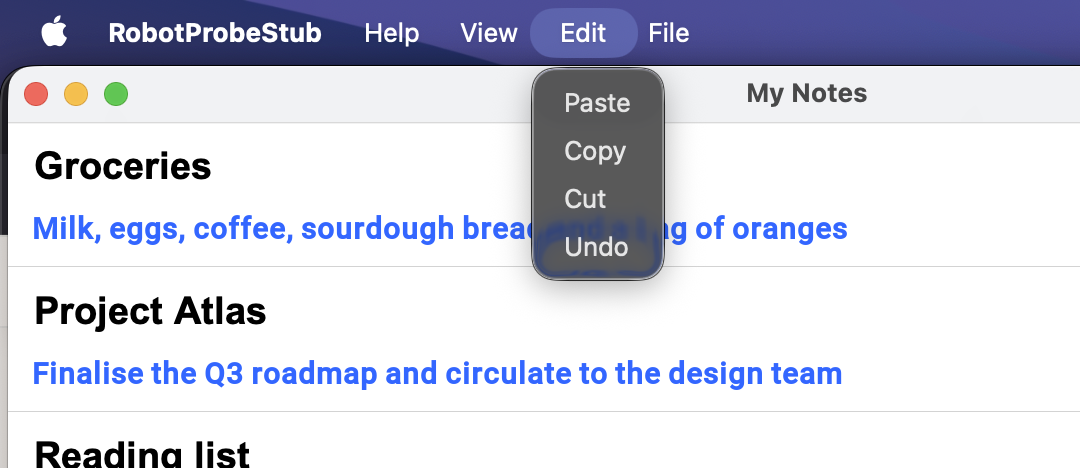
native mode: the Form title is in the OS window title bar, the commands populate the native menu bar, and there is no in-app Toolbar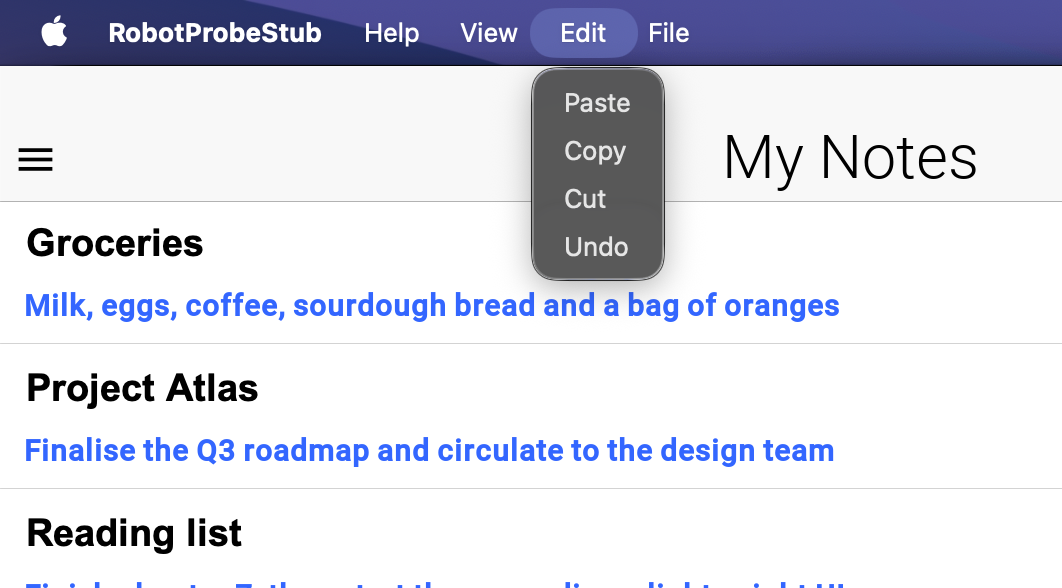
custom mode: the window is undecorated and the CN1 Toolbar (title + hamburger side menu) is the window’s title bar; the commands are also in the native menu bar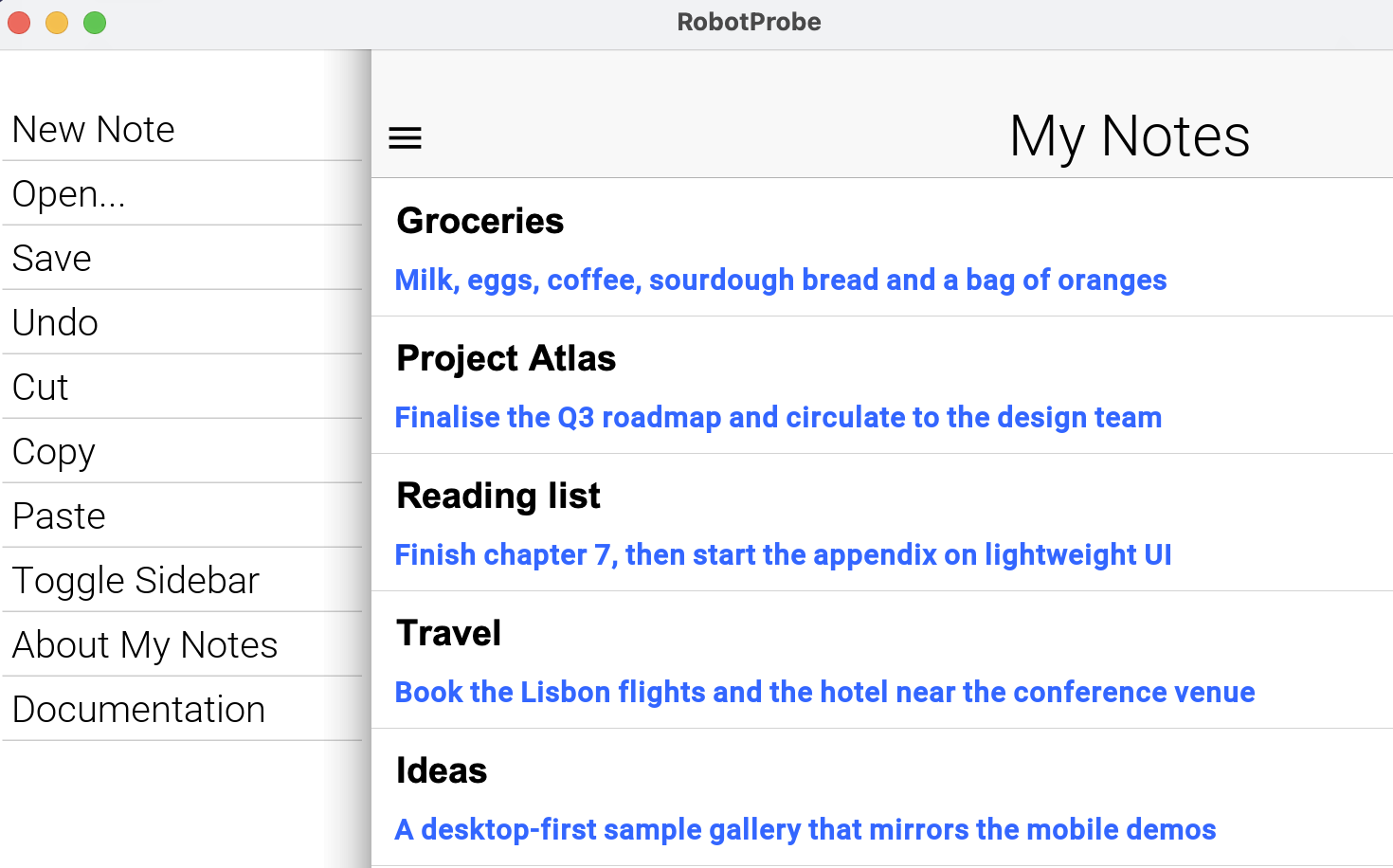
toolbar mode: the legacy look - the in-app Toolbar sits below a generic OS title bar and the commands live in the hamburger side menuEnabling it on the Java SE desktop build
For the desktop (Java SE) target the mode is a build hint that the generated desktop launcher
applies for you. In codenameone_settings.properties:
codename1.arg.desktop.titleBar=native
codename1.arg.desktop.interactiveScrollbars=true
Newly generated projects already contain these lines. The generated <MainName>Stub reads them
at startup, so no code is required. Because the stub is the desktop entry point, the settings only
ever take effect on the desktop.
Enabling it on the native macOS build
The local mac-source build runs through ParparVM, where the chrome is the application’s own
NSWindow and NSMenu. There it’s read as a runtime property and defaults to toolbar, so
existing apps are unaffected. Opt in from your app before the first Form is shown:
Display.getInstance().setProperty("desktop.titleBar", "native");
Display.getInstance().setProperty("desktop.interactiveScrollbars", "true");
UIWindowScene and UIMenuBuilder rather than AppKit; see
Working with Mac Catalyst.Native menu bar and command placement hints
When the Toolbar is hidden (native or custom mode), the commands you add through the
Toolbar / Form command API are bridged to the platform’s native menu bar - a Swing JMenuBar
(which becomes the macOS screen menu) on the Java SE build, and an NSMenu on the native macOS build.
Selecting a menu item runs the command’s actionPerformed on the Codename One EDT, exactly as a
button press would.
By default every command lands under a single Commands menu. To place commands into the
conventional desktop menus, tag them with a desktop-menu hint using Command.setDesktopMenu(String)
and the Command.DESKTOP_MENU_* constants:
Form hi = new Form("My App", BoxLayout.y());

Command about = new Command("About My App");
about.setDesktopMenu(Command.DESKTOP_MENU_ABOUT);   // application menu

Command open = new Command("Open File...");
open.setDesktopMenu(Command.DESKTOP_MENU_FILE);     // File menu

Command quit = new Command("Quit");
quit.setDesktopMenu(Command.DESKTOP_MENU_QUIT);     // application menu

hi.addCommand(about);
hi.addCommand(open);
hi.addCommand(quit);
hi.show();
The recognized values are (case-insensitive):
| Placed in the application menu (the macOS app menu / a leading menu). |
| Placed in the matching standard top-level menu. |
Any other string | Becomes a top-level menu with that literal title. |
Unset | Grouped under a default Commands menu. |
Each port maps the hint to its native structure: on the native macOS build the command is inserted
into the application’s real NSMenu under the application, File, Edit, View, Window and Help
submenus; on the Java SE build a top-level JMenu is created per hint group.
All four desktop ports have one: a Swing JMenuBar on the Java SE build, an NSMenu on the
native macOS build, a Win32 HMENU on the Windows port and a GtkMenuBar on the Linux port.
The three ParparVM ports encode a command the same way, so one format serves every one.
Form keeps its
Toolbar there instead of hiding it - hiding it would take away the only place the commands are
drawn - and Display.COMMAND_BEHAVIOR_NATIVE normalizes back to the default rather than
dropping every command without a word. Nothing in application code branches on this.Command.DESKTOP_MENU), so it’s inert on platforms that
don’t have a native menu bar - it’s safe to set it unconditionally in shared code.Keyboard accelerators
Give a command a keyboard accelerator with Command.setDesktopShortcut(…). The shortcut is shown
next to the menu item and triggers the command from the keyboard:
Command save = new Command("Save");
save.setDesktopMenu(Command.DESKTOP_MENU_FILE);
save.setDesktopShortcut('S');   // Cmd+S on macOS, Ctrl+S on Windows/Linux

Command saveAs = new Command("Save As...");
saveAs.setDesktopMenu(Command.DESKTOP_MENU_FILE);
saveAs.setDesktopShortcut('S',
        Command.DESKTOP_SHORTCUT_MODIFIER_PRIMARY | Command.DESKTOP_SHORTCUT_MODIFIER_SHIFT);
The single-argument form uses the platform’s primary modifier - Command on macOS, Control on
Windows/Linux - which is the right default for most menu shortcuts. The
two-argument form takes a bit-mask of Command.DESKTOP_SHORTCUT_MODIFIER_PRIMARY,
Command.DESKTOP_SHORTCUT_MODIFIER_SHIFT and Command.DESKTOP_SHORTCUT_MODIFIER_ALT. On the
Java SE build the accelerator becomes a Swing KeyStroke; on the native macOS build it becomes the
menu item’s keyEquivalent and keyEquivalentModifierMask.
Like the placement hint, the accelerator is inert on platforms without a native menu bar, so it’s
safe to set unconditionally.
Interactive scrollbars
Enabling desktop.interactiveScrollbars turns the scrollbar from a fading touch indicator into a
desktop-style control:
The thumb can be grabbed and dragged, and it highlights while the pointer hovers it and while it’s being dragged (the
DesktopScrollThumbselected / pressed styles).Clicking the track pages toward the pointer by about one viewport.
The thumb has a minimum size so it stays easy to grab even when the content is far taller than the viewport. The minimum (in pixels) is the
scrollThumbMinSizeInttheme constant; when unset it defaults to the equivalent of 4mm.A gutter is reserved for the scrollbar so content isn’t laid out underneath it. The gutter width comes from the
DesktopScroll/DesktopHorizontalScrollUIID padding (see below).The scrollbar stays visible rather than fading out.
This is a cross-platform core feature driven by the interactiveScrollBool theme constant, which
the desktop ports inject only when CN.isDesktop() is true. Mouse-wheel scrolling continues to work
as before.
Theme UIIDs
When interactive scrollbars are active, the desktop scrollbar is styled through dedicated UIIDs so the
mobile Scroll / ScrollThumb styling is never affected:
| The interactive desktop scrollbar track and thumb. The horizontal-/vertical-scroll UIID’s padding
sets the scrollbar gutter width. The thumb UIID’s |
All the native themes ship platform-conventional defaults for these UIIDs, including the
.selected / .pressed thumb highlight states; see Native modern themes. The three desktop
themes also turn interactiveScrollBool on themselves, so a desktop build using one gets the
real scrollbar without setting the build hint. Override the UIIDs in your app’s theme.css like
any other UIID.
.selected and .pressed, not .hover. The interactive
thumb reads its selected style while the pointer is over it and its pressed style while it’s
being dragged, so a .hover rule on DesktopScrollThumb compiles and is never painted. For the
same reason, don’t write these UIIDs as cn1-derive: ScrollThumb: a derive produces the whole
state family by copying the base, so the highlight ends up identical to the resting colour -
present in the compiled theme and invisible on screen.
The minimum thumb length is the scrollThumbMinSizeInt theme constant (pixels). In custom mode the
title bar is just the regular CN1 Toolbar, so it’s themed through the usual Toolbar / Title
UIIDs.Desktop notifications
The standard com.codename1.notifications.LocalNotification API works on the desktop. On the
Java SE desktop build a scheduled notification surfaces as a native OS notification through the
system tray (Notification Center on macOS, the notification area on Windows/Linux); on the
native macOS build it goes through the same UNUserNotificationCenter path as iOS. Clicking
the notification delivers it to your app’s LocalNotificationCallback, exactly as on mobile, so the
same scheduling and handling code is shared across phone and desktop:
LocalNotification n = new LocalNotification();
n.setId("reminder-1");
n.setAlertTitle("Reminder");
n.setAlertBody("Your export has finished.");

// fire in 5 seconds, no repeat
Display.getInstance().scheduleLocalNotification(
        n, System.currentTimeMillis() + 5000, LocalNotification.REPEAT_NONE);
java.awt.SystemTray); where it’s unavailable the notification is logged and skipped.