Codename One ships a first-class Bluetooth API under com.codename1.bluetooth that covers both Bluetooth Low Energy roles and classic Bluetooth: scan for and connect to BLE peripherals (the GATT client), act as a BLE peripheral (a local GATT server plus advertising), stream bytes over L2CAP connection-oriented channels, and exchange RFCOMM streams with classic serial devices.
Bluetooth.getInstance() is the single entry point and never returns null — ports without Bluetooth return a fallback whose operations fail fast with BluetoothError.NOT_SUPPORTED, so calling code needs no platform-specific if. Every callback of the API — AsyncResource results, scan sightings, connection events, notifications, adapter state changes — is delivered on the EDT; the only exceptions are the blocking RFCOMM/L2CAP streams, which must be consumed off the EDT.
| Capability | Android | iOS / macOS | Simulator (mock) | Simulator (native backend) | JavaScript |
|---|---|---|---|---|---|
BLE central (scan, GATT client) | yes | yes | yes | yes | browser chooser only |
BLE peripheral (GATT server + advertising) | yes | yes (not tvOS/watchOS) | yes | — | — |
L2CAP channels | yes (Android 10+) | yes (iOS 11+) | yes | — | — |
Classic RFCOMM | yes | — | yes | — | — |
Bonding | yes | OS-managed | yes | — | — |
On the JavaScript port, Web Bluetooth limits the central role to the browser’s device chooser (Chrome-family browsers over HTTPS): startScan(…) surfaces the chooser built from the scan filters and delivers the single user-picked device as one ScanResult. No further sightings ever arrive, the RSSI is unknown, the MTU is fixed at 512 and peripheral mode, classic Bluetooth and L2CAP are unavailable.
Always branch through the capability queries — isLeSupported(), isPeripheralModeSupported(), isL2capSupported(), isClassicSupported() — rather than through platform detection.
Quick start: Scan and connect
Bluetooth bt = Bluetooth.getInstance();
if (!bt.isLeSupported()) {
    // hide the feature on ports without BLE
    return;
}
bt.requestPermissions(BluetoothPermission.SCAN, BluetoothPermission.CONNECT)
        .onResult((granted, permissionErr) -> {
    if (permissionErr != null || !granted) {
        return;
    }
    ScanSettings settings = new ScanSettings()
            .addFilter(new ScanFilter()
                    .setServiceUuid(BluetoothUuid.fromShort(0x180D))
                    .setNamePrefix("Polar"));
    BleScan[] scan = new BleScan[1];
    scan[0] = bt.getLE().startScan(settings, sighting -> {
        scan[0].stop();
        sighting.getPeripheral().connect()
                .onResult((peripheral, connectErr) -> {
            if (connectErr != null) {
                return;
            }
            peripheral.discoverServices()
                    .onResult((services, discoverErr) -> {
                // the GATT database is ready -- see the
                // following sections
            });
        });
    });
});
ScanFilter criteria on one filter are AND-combined; multiple filters added to the same ScanSettings are OR-combined, and a scan without filters reports every advertising device. Any number of scans may run concurrently — each BleScan handle only sees advertisements matching its own filters, and the platform scan stops when the last handle stops. On iOS a service-UUID filter is also what keeps scans alive in the background, so prefer filtered scans.
Peripheral addresses returned by BluetoothDevice.getAddress() are stable per app install — the MAC address on Android and desktop, the per-app CoreBluetooth identifier on iOS — and safe to persist for later reconnection through BluetoothLE.getPeripheral(String). They’re not portable across devices or platforms, so never treat them as the peripheral’s real hardware address.
getAdapterState() reports where the local radio stands (POWERED_ON, POWERED_OFF, UNAUTHORIZED, …) and addAdapterStateListener(…) fires on the EDT whenever it changes — the natural place to pause scans and gray out UI. requestEnable() shows the Android system dialog asking the user to turn the adapter on; on iOS there is no programmatic enable flow, so it resolves false and the app should direct the user to the Settings app instead.
Connection lifecycle is equally explicit. connect(ConnectionOptions) accepts a timeout (iOS connect requests never time out on their own, so set one) and an autoConnect flag that asks the platform to re-establish the link whenever the peripheral comes back into range. addConnectionListener(…) reports every transition including link loss, and every failure across the API surfaces as a BluetoothException whose getError() returns a typed BluetoothError constant — no string matching required.
Reading and writing characteristics
discoverServices() caches the peripheral’s GATT database; from there getService(…), getCharacteristic(…) and the convenience accessors on GattCharacteristic cover the day-to-day operations:
GattCharacteristic measurement = peripheral.getCharacteristic(
        BluetoothUuid.fromShort(0x180D),
        BluetoothUuid.fromShort(0x2A37));
if (measurement != null && measurement.canRead()) {
    measurement.read().onResult((data, err) -> {
        if (err == null) {
            // raw bytes, delivered on the EDT
            updateHeartRateLabel(data[1] & 0xFF);
        }
    });
}

GattCharacteristic controlPoint = peripheral.getCharacteristic(
        BluetoothUuid.fromShort(0x180D),
        BluetoothUuid.fromShort(0x2A39));
if (controlPoint != null && controlPoint.canWrite()) {
    controlPoint.write(new byte[] {1})
            .onResult((acknowledged, err) -> {
        // resolves once the peripheral acknowledged the write
    });
}
All GATT operations return independent AsyncResource handles and may be issued concurrently: an internal per-peripheral queue serializes them toward the platform stack (which allows only one in-flight request per connection) and applies a safety timeout, so a lost platform callback can never wedge the queue. Operations on different peripherals run fully concurrently. writeWithoutResponse(…) resolves once the value is queued to the controller — there is no remote acknowledgement.
A default BLE connection carries 23 bytes per attribute operation; requestMtu(…) negotiates a larger value and resolves with what was granted (on iOS the OS negotiates by itself, so the request resolves immediately with the current value — check getMtu() before chunking data). requestConnectionPriority(…) trades latency against battery on Android and is a successful no-op on iOS. createBond() initiates pairing where the peripheral requires an encrypted link; on iOS bonding is OS-managed and triggered automatically by encrypted characteristics, so the call resolves true without user interaction.
Notifications
GattCharacteristic measurement = peripheral.getCharacteristic(
        BluetoothUuid.fromShort(0x180D),
        BluetoothUuid.fromShort(0x2A37));
GattNotificationListener listener = (characteristic, data) -> {
    // fires on the EDT for every notification while subscribed
    updateHeartRateLabel(data[1] & 0xFF);
};
measurement.subscribe(listener).onResult((armed, err) -> {
    if (err != null) {
        // the CCCD write was rejected or the link dropped
    }
});

// later, e.g. when leaving the form:
measurement.unsubscribe(listener);
The Client Characteristic Configuration descriptor (CCCD) is handled automatically: the first listener triggers the descriptor write that arms notifications (indications are used when the characteristic only supports those) and removing the last listener disarms it again. Values stream to the listeners on the EDT until unsubscribed or disconnected.
Peripheral mode
When isPeripheralModeSupported() returns true the device can serve data itself — open a local GATT server, add service definitions and advertise them:
Bluetooth bt = Bluetooth.getInstance();
if (!bt.isPeripheralModeSupported()) {
    return;
}
GattLocalCharacteristic status = new GattLocalCharacteristic(
        BluetoothUuid.fromShort(0x2A37),
        GattCharacteristic.PROPERTY_READ
                | GattCharacteristic.PROPERTY_NOTIFY,
        GattLocalCharacteristic.PERMISSION_READ)
        .setValue(new byte[] {0, 72});
GattLocalService service = new GattLocalService(
        BluetoothUuid.fromShort(0x180D))
        .addCharacteristic(status);
bt.getLE().openGattServer(new GattServerAdapter() {
    @Override
    public void centralConnected(BleCentral central) {
        // a central connected to this device
    }

    @Override
    public void characteristicWriteRequest(GattWriteRequest request) {
        // handle the written bytes, then acknowledge
        if (request.isResponseRequired()) {
            request.respond();
        }
    }
}).onResult((server, err) -> {
    if (err != null) {
        return;
    }
    server.addService(service).onResult((added, addErr) -> {
        if (addErr != null) {
            return;
        }
        bt.getLE().startAdvertising(
                new AdvertiseSettings(),
                new AdvertiseData()
                        .addServiceUuid(BluetoothUuid.fromShort(0x180D))
                        .setIncludeDeviceName(true),
                null).onResult((advertisement, advErr) -> {
            // broadcasting; keep the handle and stop() it when done
        });
        // push a new value to every subscribed central
        server.notifyValue(status, new byte[] {0, 80});
    });
});
Characteristics with a static value (setValue(…)) are served without involving the listener; characteristics without one route every read to characteristicReadRequest(…), which must answer via respond(…) or reject(…) — centrals time out unanswered requests.
Two iOS platform notes: CoreBluetooth only broadcasts the local name and service UUIDs, dropping manufacturer data, service data and TX power from advertisements (Android broadcasts everything). And iOS serves descriptors from their static values only — descriptor read/write requests never reach the listener there, so always give local descriptors a static value for cross-platform behavior.
L2CAP channels
L2CAP connection-oriented channels provide a raw bidirectional byte stream — much higher throughput than chunking data through GATT characteristics. The peripheral side opens a listener and publishes its Protocol/Service Multiplexer (PSM), typically through a GATT characteristic; the central side connects to that PSM:
if (!Bluetooth.getInstance().isL2capSupported()) {
    return;
}
peripheral.openL2capChannel(psm, true).onResult((channel, err) -> {
    if (err != null) {
        return;
    }
    // the streams block -- always consume them off the EDT
    CN.startThread(() -> {
        try {
            OutputStream out = channel.getOutputStream();
            out.write(new byte[] {1, 2, 3});
            out.flush();
            InputStream in = channel.getInputStream();
            byte[] buffer = new byte[4096];
            int size = in.read(buffer);
            // process the response...
        } catch (IOException ioErr) {
            // transport failure
        } finally {
            try {
                channel.close();
            } catch (IOException ignored) {
            }
        }
    }, "L2CAP IO").start();
});

// the peripheral side listens and publishes its PSM to centrals
Bluetooth.getInstance().getLE().openL2capServer(true)
        .onResult((server, serverErr) -> {
    if (serverErr == null) {
        int assignedPsm = server.getPsm();
        // advertise assignedPsm through a GATT characteristic,
        // then server.accept() incoming channels
    }
});
On Android an L2CAP channel establishes its own link and doesn’t require connect() first; on iOS the peripheral must be connected. The streams throw plain java.io.IOException on transport failure and, like all Bluetooth streams, block — never touch them on the EDT.
Classic Bluetooth
Classic (BR/EDR) Bluetooth covers inquiry discovery, bonding and RFCOMM stream connections — the Serial Port Profile (SPP) world of printers, scanners and industrial equipment. iOS doesn’t expose classic Bluetooth to applications, so this role is Android, desktop and simulator only; isClassicSupported() is the gate:
Bluetooth bt = Bluetooth.getInstance();
if (!bt.isClassicSupported()) {
    // classic Bluetooth is unavailable -- iOS among others
    return;
}
BluetoothClassic classic = bt.getClassic();
classic.startDiscovery(sighting -> {
    if ("SerialPrinter".equals(sighting.getDevice().getName())) {
        classic.connect(sighting.getDevice(), BluetoothUuid.SPP, true)
                .onResult((connection, err) -> {
            if (err != null) {
                return;
            }
            // consume the blocking streams off the EDT, exactly
            // like the L2CAP example
        });
    }
});

// accepting incoming SPP clients
classic.listen("Codename One SPP", BluetoothUuid.SPP, true)
        .onResult((server, err) -> {
    if (err == null) {
        server.accept().onResult((connection, acceptErr) -> {
            // one client accepted; call accept() again for the next
        });
    }
});
startDiscovery(…) runs an inquiry scan (about 12 seconds) and returns a live ClassicDiscovery handle that resolves when the inquiry ends. getBondedDevices() lists already-paired devices without a discovery, and connect(String, BluetoothUuid, boolean) reconnects to a persisted address directly.
Permissions and build hints
The build pipeline scans the application’s bytecode and injects only what the referenced packages need — apps that never touch com.codename1.bluetooth see no manifest or plist change, and a central-only app never carries advertise permissions.
| Detected usage | Android injected (target SDK 31+) | iOS injected |
|---|---|---|
Any |
|
|
Scanning ( |
| — |
Connections (GATT, |
| — |
Peripheral mode ( |
| — |
Classic ( |
| not supported |
Builds targeting an SDK below 31 receive the legacy permissions uncapped and none of the Android 12 ones. Permissions you declare yourself (via android.xpermissions) are never duplicated.
Override the defaults with the matching build hints:
| Build hint | Default | Notes |
|---|---|---|
|
| Declares that scan results never derive the user’s location, which caps |
|
| Marks the BLE hardware feature required so stores hide the app on devices without it |
| (none) |
|
| "Communicates with nearby Bluetooth accessories." | Localise this — Apple rejects builds that ship generic privacy copy |
Beacon and indoor-positioning apps are the one case where the neverForLocation default is wrong: an app that derives location from BLE sightings must set android.bluetooth.neverForLocation=false, otherwise Android 12+ filters beacon advertisements out of its scan results. With the hint set to false the location permission stays uncapped and the app keeps prompting for it on Android 12+.
Simulator support
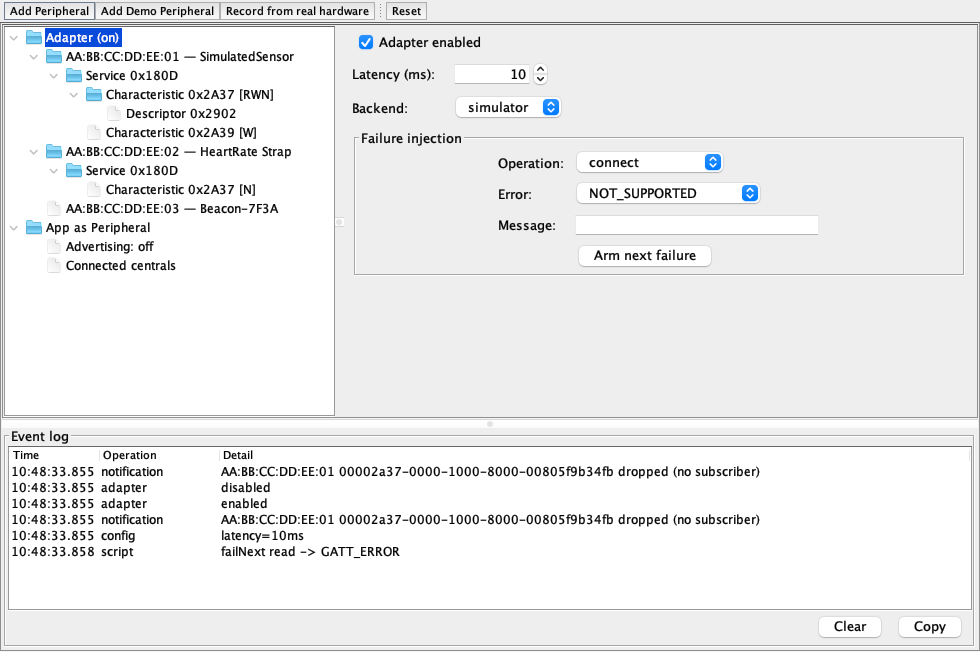
The JavaSE simulator implements the whole API against a scriptable virtual Bluetooth stack. Simulate → Bluetooth Simulation opens a window with a tree of the simulated adapter, the virtual peripherals and the app’s own peripheral role; selecting a node opens its detail editor (hex value editors on characteristics), a toolbar stages demo devices, failure injection arms the next operation of a chosen kind (connect, read, write, discover, subscribe, scan and the rest) to fail with a chosen BluetoothError, a latency spinner delays every asynchronous completion and a live event log shows what the stack does. All settings persist between simulator runs.
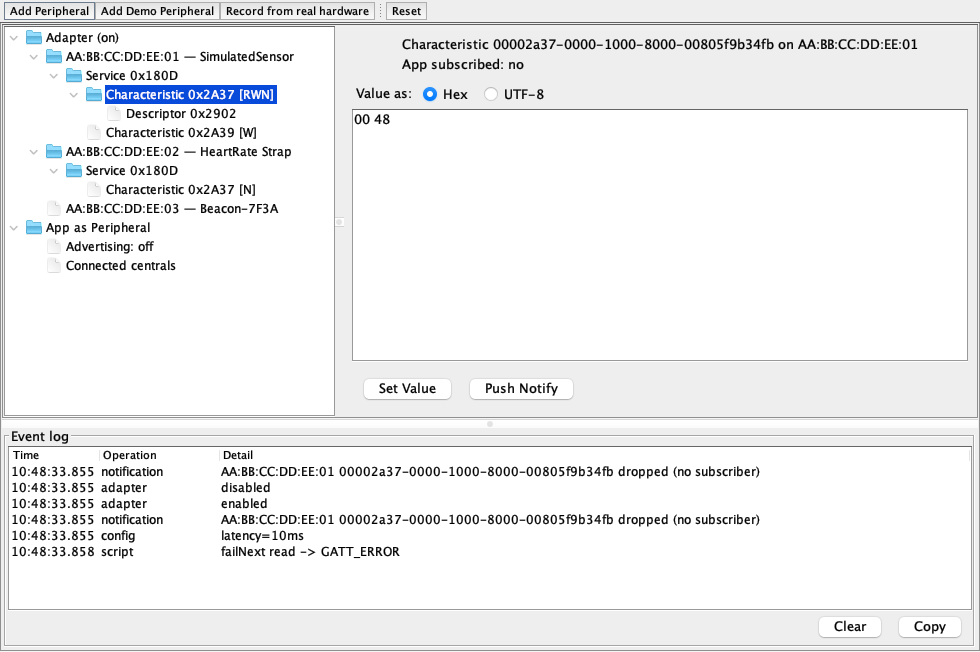
The window’s backend selector switches the simulator between the virtual stack and a native backend that drives the host machine’s real Bluetooth radio through a bundled btleplug library (libcn1ble) loaded in-process (CoreBluetooth on macOS, BlueZ on Linux, WinRT on Windows). The native backend is central-only — real scanning, connections and GATT operations against physical devices, without leaving the simulator. The initial backend comes from the cn1.bluetooth.backend system property (default simulator); point cn1.bluetooth.libraryPath at a locally built libcn1ble to override the bundled one.
The Simulate → Bluetooth menu exposes the same operations as one-click hooks; every item is also callable from cross-platform code via CN.execute("bluetooth:itemN"):
| Hook | Menu label | Effect |
|---|---|---|
| Toggle Adapter | Flips the simulated adapter between |
| Add Demo Peripheral | Registers the canonical demo device: |
| Push Demo Notification | Pushes a rolling one-byte notification from the demo peripheral’s |
| Disconnect All | Drops every live connection from the remote side |
| Clear Peripherals | Removes every registered virtual peripheral |
| Use Simulator Backend | Switches back to the virtual stack |
| Use Native Backend | Switches to the host machine’s real radio |
| (API only) | Arms the next GATT read to fail with |
Everything the window does goes through the scriptable BluetoothSimulator API in com.codename1.impl.javase.bluetooth, so tests and sample apps can stage the same devices programmatically. This code runs against the JavaSE port only — it isn’t part of the cross-platform API and won’t compile in a portable code base, so keep it in your test or debug scaffolding:
BluetoothSimulator.addPeripheral(
        new VirtualPeripheral("AA:BB:CC:DD:EE:10")
                .setName("Thermometer")
                .addAdvertisedServiceUuid(BluetoothUuid.fromShort(0x1809))
                .withService(new VirtualService(BluetoothUuid.fromShort(0x1809))
                        .withCharacteristic(new VirtualCharacteristic(
                                BluetoothUuid.fromShort(0x2A1C),
                                GattCharacteristic.PROPERTY_READ
                                        | GattCharacteristic.PROPERTY_INDICATE,
                                new byte[] {0, 0, 0, 98})
                                .withDescriptor(new VirtualDescriptor(
                                        BluetoothUuid.CCCD, new byte[] {0, 0})))));
BluetoothSimulator.setLatencyMillis(50);
BluetoothSimulator.failNext("connect",
        BluetoothError.CONNECTION_FAILED, "Injected for testing");
Record and replay
Fixtures bridge the two backends: the window’s "Record from real hardware" button (or scripts/bluetooth/capture-fixture.sh) scans the host machine’s real radio through the native backend for a chosen duration, captures device identities, RSSI timelines, advertisement payloads and GATT databases, scrambles the trace deterministically so committed fixtures never carry real device identities, and writes it as JSON. BluetoothSimulator.loadFixture(InputStream) replays the trace into the virtual stack — devices appear at their recorded first-sighting times and their RSSI timelines replay on the stack’s scheduler, so a scan against messy real-world radio traffic becomes a reproducible test input.
Testing
Cross-platform test code drives the simulation through the hooks: CN.execute("bluetooth:item2") stages the demo peripheral, the test scans for SimulatedSensor, connects and subscribes to 0x2A37, and CN.execute("bluetooth:item3") pushes a notification to assert on — no simulator-only imports needed, so the same test class compiles for device targets and runs unchanged in the simulator’s test runner. Failure paths test the same way: CN.execute("bluetooth:item8") arms the next GATT read to fail with GATT_ERROR, letting a portable test verify the app’s error handling.
For fully deterministic unit tests the JavaSE port also allows constructing a private SimulatedBluetoothStack on a ManualScheduler, where time only advances when the test pumps it — no sleeps, no flakiness from real timers; see the Bluetooth tests under the javase Maven module for the pattern.
Platform behaviour
| Platform | Address semantics | MTU | Bonding | Notes |
|---|---|---|---|---|
Android | Real MAC address |
|
| Background scanning is throttled by the OS; use filtered scans and expect slower sightings |
iOS / macOS | Per-app CoreBluetooth identifier UUID | Negotiated by the OS; | OS-managed, triggered by encrypted characteristics; | Background operation needs |
Simulator (mock) | Synthetic ( | Simulated negotiation | Simulated | Timestamps come from a monotonic counter — treat them as ordered, not as wall-clock times |
Simulator (native backend) | Host-OS device identifier | Real negotiation | Not supported | Central role only; requires the bundled |
JavaScript | Per-origin Web Bluetooth identifier | Fixed at 512 | Browser-managed | One user-picked device per chooser; |
Persist addresses only for same-install reconnection, branch on the capability queries rather than on Display.getPlatformName(), and keep every byte-stream consumer off the EDT — those three rules keep one code base working across every column of the capability matrix.