Bazaar began as a copy of Savor and kept what a store needs from it: the module layout, the accounts and sign-in, the cards and the payment provider, text messages, push notifications, the live channel, the operations console and hosting the app in a browser. This chapter covers what a commerce platform adds: a catalog with variants, an inventory ledger that never oversells, orders paid in two steps, a point of sale that keeps selling with no network, fulfilment, signed webhooks, automations drawn as graphs, documents rendered as PDF files and a storefront that search engines can read. Bazaar: Feature comparison lists what Bazaar has and lacks, next to other commerce platforms.
Running it
The project is in scripts/bazaar. Start the server on the development profile,
which seeds the demo accounts, two stores with their products and stock, and
simulates the cards:
CN1_PROFILE=dev backend/server.sh runThen run the app in the simulator, from the project’s directory:
mvn verify -Psimulator -DskipTests -Dcodename1.platform=javasebackend/server.sh run --web builds the app for a browser as well and serves it at
http://localhost:8080/. The same server also serves the HTML storefront under
/s/<handle>, described in A storefront search engines can read.
The modules
shared holds the contract: the data transfer objects and the @RestClient
interfaces both sides compile against. common is the app, one adaptive app for
phones, tablets, desktops, and browsers. backend is the server. Its packages
follow the domain:
| Package | What it holds |
|---|---|
| Stores, their staff and locations, products, options, variants and collections. |
| Stock per variant and location, the move ledger, counts, transfers, suppliers and purchase orders. |
| Carts for guests and accounts, the quote (discounts, tax, shipping) and placing an order. |
| Orders and their events, fulfilments and tracking, refunds and returns, gift cards. |
| The payment provider: holds, captures, voids and refunds. |
| Registers, shifts, cash moves and the offline sale sync. |
| Signed outgoing webhooks and the automation engine. |
| Invoices, packing slips, labels, purchase orders, credit notes, shift reports and receipts as PDF files. |
| The server-rendered storefront. |
| Store statistics and the platform console. |
The app’s packages split the same way by audience: shop for shoppers,
merchant for store staff, pos for the register, admin for the platform, and
ui for the shell they share. Which of them a person sees follows the roles the
server returns: a shopper opens on the storefront, store staff on the merchant
dashboard, a cashier on the register, an administrator on the platform console.
Money is a long count of minor units everywhere, on both sides and in every
transfer object. Nothing stores or adds money as a floating point number.
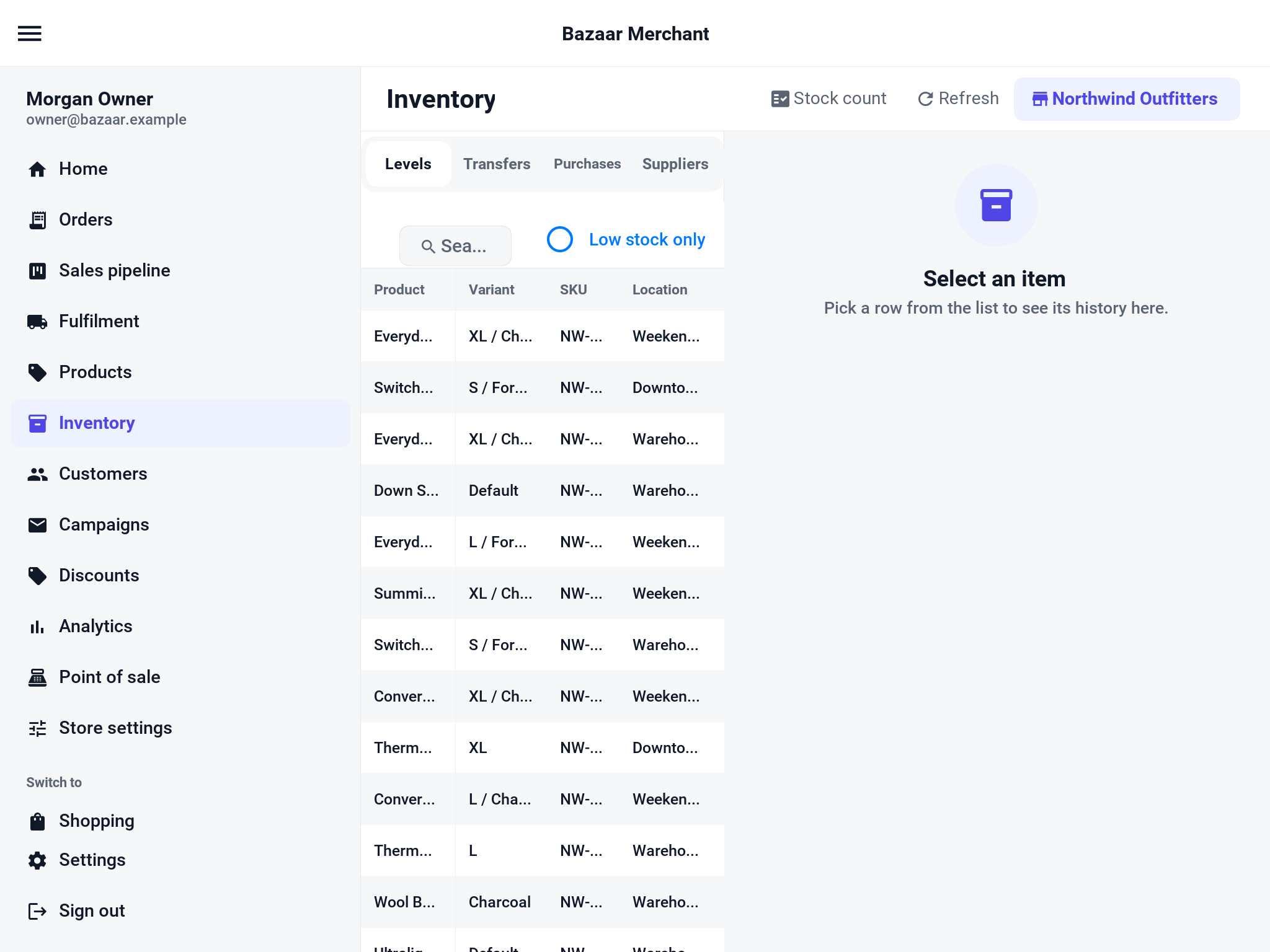
The inventory ledger
Stock is one InventoryLevel row per variant and location, holding what’s on
hand, what’s committed to placed orders, and what’s incoming on purchase
orders. What can be sold is on hand less committed. No code writes a level
without writing an InventoryMove in the same transaction, with a reason
(SALE, RESERVE, RELEASE, RETURN, RESTOCK, COUNT, DAMAGE,
TRANSFER_OUT, TRANSFER_IN, RECEIVE, CORRECTION or POS_SYNC), so the
history of every number is in the moves and the levels can be rebuilt from them.
Checkout reserves stock through Inventory.reserve, a conditional update that
names the version of the level it read and retries a lost race. Two shoppers
buying the last unit at the same moment therefore can’t both succeed:
@Transactional(rollbackFor = IOException.class)
public boolean reserve(String storeId, String variantId, String locationId, int qty,
        String reference, String username) throws IOException {
    return reserveCounted(storeId, variantId, locationId, qty, reference, username) >= 0;
}

/// [#reserve], answering -1 when refused, otherwise how many of the
/// `qty` units were promised past zero: 0 unless the variant continues
/// selling when out of stock and fewer than `qty` were available. The
/// order line keeps that figure as its backordered units.
@Transactional(rollbackFor = IOException.class)
public int reserveCounted(String storeId, String variantId, String locationId, int qty,
        String reference, String username) throws IOException {
    Variant variant = variant(storeId, variantId);
    location(storeId, locationId);
    positive(qty);
    List<Bundles.Part> parts = bundles.partsOfVariant(variantId);
    if (!parts.isEmpty()) {
        int backordered = 0;
        // A bundle holds no stock: its components are promised, all or
        // none -- a later component that is short gives the earlier back.
        for (int iter = 0; iter < parts.size(); iter++) {
            Bundles.Part part = parts.get(iter);
            int part0 = reserveCounted(storeId, part.variantId, locationId,
                    qty * part.quantity, reference, username);
            if (part0 > backordered) {
                backordered = part0;
            }
            if (part0 < 0) {
                for (int back = 0; back < iter; back++) {
                    release(storeId, parts.get(back).variantId, locationId,
                            qty * parts.get(back).quantity, reference, username);
                }
                return -1;
            }
        }
        return backordered;
    }
    if (!variant.isTrackInventory()) {
        return 0;
    }
    if (variant.isAllowBackorder()) {
        change(storeId, variantId, locationId, 0, qty, 0, RESERVE, reference, username);
        // Read after the relative update: what this order took beyond
        // what was there, never more than it asked for.
        int after = available(variantId, locationId);
        return after >= 0 ? 0 : Math.min(qty, -after);
    }
    InventoryLevel level = level(storeId, variantId, locationId);
    if (levels.reserveIf(level.getId(), qty, Instant.now()) != 1) {
        return -1;
    }
    record(storeId, variantId, locationId, 0, qty, RESERVE, reference, username);
    return 0;
}
Shipping a fulfilment takes the units out of on hand and committed together;
cancelling an order releases what it reserved. A return that’s restocked writes
a RETURN move. Counting a shelf writes the difference as a COUNT move rather
than overwriting the number.
The one exception to "never below zero" is the register. A sale made offline has
already happened: the customer left with the goods. The sync records it with a
POS_SYNC move even when that takes a level negative, marks the sale as
oversold, and raises a low-stock alert for a person to sort out.
Two more kinds of stock sit beside on hand. inventory_unavailable holds units
set aside with a reason, which InventoryStates subtracts from available, and
Tracking keeps serials and lots: a sale that takes a lot-tracked level down
calls pickLots, which draws from the lot that expires first. A variant that
continues selling reserves with reserveCounted, which answers how many units
it couldn’t cover; the order line keeps that as backorderedQty.
Pay links, returns and templates
A pay link (PayLinks) is a row in pay_link holding a token of the link id,
its expiry and an HMAC of both, so a link can’t be forged or extended and a new
link replaces the old. Paying claims the link first and reverts the claim if the
card fails, so two tabs can’t pay twice. The invoice reads the stored token
rather than calling PayLinks, which keeps Documents free of a dependency on
email.
Returns read their rules from OrderSettings. Resolutions settles a received
return by the resolution the shopper picked: every path goes through the order’s
own refund, with the fees and any exchange credit kept back, so the order’s
totals and the card agree. An exchange creates a replacement order, pays it with
the credit as an EXCHANGE tender, and mails a pay link when money is still
owed.
Templates keeps a store’s rewording of a mail.* key per language. Emails
looks a key up there before the built-in text; a template may only use the
placeholders the built-in text has, and is filled as plain text, never markup.
A bundle has no level of its own. Bundles keeps its components (variant and
quantity per unit, in bundle_component), and a product is a bundle exactly
when it has component rows. Every stock call (reserve, release, ship, restock,
the register’s sale and a marketplace order) expands a bundle line into moves
on its components, so the ledger stays the one record of stock. What a bundle
can sell is the fewest bundles its components make at each location, summed
over the locations; an untracked component never limits it. A product that’s a
component can’t itself be a bundle, and a component variant can’t be deleted.
Each product also has a publishing window per channel in channel_schedule:
ONLINE, POS, or a marketplace channel’s id, with publish and unpublish times
in UTC. Schedules.set applies a window at once, and a scheduled job flips the
visible flag as times pass. The storefront (lists, search, the product page,
the sitemap and the feeds), carts and checkout read ONLINE; the register’s
catalog reads POS; and marketplace sync pushes a hidden listing with no stock.
A product with no window follows its status alone.
A variant’s digital flag means it ships nothing: it weighs nothing in a
quote, holds no stock, and a cart of digital variants only needs no address or
delivery option. Uploaded files (downloads, videos and models) live in
catalog_file, capped by bazaar.catalog.max-file-bytes; a video or model is
checked by its leading bytes, not its declared type. Downloads keeps each
variant’s digital_asset and, once an order is paid, one download_grant per
digital line. When an order is placed, StoreEvents marks its digital lines
fulfilled, which takes a held card payment the same way shipping does, so the
confirmation mail already carries the links. A link is the grant id, its expiry
and an HMAC of both under the grant’s own random secret; a forged, foreign,
expired, used-up or revoked link answers the same 404. Each fetch is counted by
one conditional update, so the limit holds under concurrent requests, and a
download is never served in byte ranges. License keys are claimed one by one
with an update that only a free key passes, so two sales never share one; a pool
with five or fewer keys left mails the store’s low-stock alert. A line refunded
in full, or a cancelled order, revokes its grants.
Gallery rows in product_photo have a kind: IMAGE, VIDEO or MODEL. An
uploaded video or model is served at /media/file/{id} with single byte ranges
and a year of caching; a linked video is a link out, since the page policy only
allows media-src 'self'. The product’s main photo is always its first picture.
A product page with a model loads Google’s <model-viewer> from
web-src/model-viewer.js (licenses in web-src/MODEL-VIEWER-NOTICE.txt) as a
module script from /static; no other page loads it. Its policy adds blob: to
img-src and connect-src (WebHeaders.allowModelViewer), since the viewer
decodes a model’s textures from URLs it makes itself, and nothing else. The
viewer fetches Draco and KTX2 decoders from Google’s servers, which the policy
refuses, so a model compressed that way shows its poster.
product.category_id is an id from the first two levels of Google’s product
taxonomy, read from taxonomy/google-product-taxonomy.txt by Taxonomy; the
app searches it through GET /api/shop/taxonomy. Variants carry hs_code,
origin_country and unit pricing: unit_quantity in thousandths of
unit_name, priced per unit_reference of unit_reference_name.
UnitPricing in shared computes the unit price in cents, half up, and answers
-1 for no measure, two kinds of unit or a result too large to compute.
Authorize at checkout, capture at shipping
An online order holds its total on the card when it’s placed and takes the
money when the first fulfilment ships. A cancelled order voids the hold, and
refunds can be partial, line by line or by amount. Point of sale orders and
pickup orders capture at once.
Try before you buy (order.Trials, migration V190, TrialApi) keeps an
order with a trial product AUTHORIZED: Orders.capturePayment waits while
its trial_order row is OPEN, the bazaar-trial-captures scheduled job
captures once the trial ends, and Returns.request inside the trial calls
Orders.voidHeld. A trial lasts at most 6 days from checkout, since a card
authorization expires after about 7.
The merchant app sets it from merchant.ProductOffers through Api.trials().
Post-purchase upsell and Buy now (checkout.Upsells, migration V210,
UpsellApi): store_upsell holds one product per store; accept places one
unit as a new order through Checkouts.place with a scratch cart, the
original’s address and the Payment.methodId it was paid with (no saved card,
no offer), so it’s reserved, quoted and authorized like any checkout and the
paid order is never mutated. upsell_order links the two and makes the offer
single use; notes on both orders name the other. buyNow is the same
single-line order to a saved address on the default card, keyed for
idempotency, leaving the shopper’s cart alone.
/// Holds an order's total on the customer's card as the order is placed,
/// with no transaction open, and records the payment as [#AUTHORIZED].
/// Asking again for the same order answers the hold already made.
///
/// @return the hold's reference, or [#CASH] for an order paid in cash
/// - `ResponseStatusException` 402: when the card was refused
public String authorize(String orderId, String username, String methodId, long amountCents,
        String currency) throws IOException {
    return authorize(orderId, username, methodId, amountCents, currency, false);
}

/// [#authorize], and with `journaled` the hold is first written down as an
/// attempt ([PaymentRecovery]): checkout does this, so a hold a crash
/// leaves behind before the order records it is found and settled.
public String authorize(String orderId, String username, String methodId, long amountCents,
        String currency, boolean journaled) throws IOException {
    if (amountCents < 0) {
        throw new ResponseStatusException(400, "That is not an amount");
    }
    Payment kept = payment(orderId);
    if (kept != null) {
        return kept.getProviderRef();
    }
    String[] chosen = choose(username, methodId);
    String reference = CASH;
    if (!CASH.equals(chosen[0])) {
        String[] references = chargeable(username, chosen[0]);
        if (references == null) {
            throw new ResponseStatusException(402, "The card is no longer on the account");
        }
        String key = authorizeKey(orderId, references[1], amountCents);
        if (journaled) {
            recordAttempt(orderId, username, key, references[0], amountCents, currency);
        }
        try {
            reference = cut(provider.authorize(key,
                    references[0], references[1],
                    amountCents, currency, "Bazaar order"), 64);
        } catch (PaymentDeclinedException declined) {
            // Refused outright: nothing is held, nothing to recover.
            dropAttempt(orderId);
            throw new ResponseStatusException(402, declined.getMessage());
        } catch (IOException unknown) {
            throw unavailable("card check", unknown);
        }
    }
    keepPayment(orderId, username, chosen, amountCents, currency, reference);
    return reference;
}
Everything provider specific sits behind PaymentProvider. The development
profile uses a simulated provider; the Stripe implementation adds a card on
Stripe’s own page, so a card number never reaches the app or this server.
public interface PaymentProvider {
    /// `simulated` or `stripe`: what the app is told, so it knows how to add a
    /// card.
    String name();

    /// Opens the processor's record of a customer and returns its reference.
    String createCustomer(String username, String displayName) throws IOException;

    /// Deletes the processor's record of a customer, and the cards saved to it
    /// with it. A record that is already gone is deleted: this is asked again
    /// when the first answer was lost.
    void forgetCustomer(String customer) throws IOException;

    /// Begins saving a card to `customer`. `setupId` is the server's own id
    /// for the attempt, for the processor to hand back.
    Setup startCardSetup(String customer, String setupId) throws IOException;

    /// Finishes a setup and returns the card it saved.
    ///
    /// @param reference what [#startCardSetup] returned as the setup's reference
    /// @param typed the card as typed into the app, for a processor whose setup
    ///     is not hosted; ignored by one whose setup is
    /// - `PaymentDeclinedException`: when the card was refused or the setup was
    ///   not finished
    Card finishCardSetup(String customer, String reference, CardDto typed) throws IOException;

    /// Takes a saved card off `customer`, so that it can't be charged again.
    /// A card that is already off, or gone, is detached: this is asked again
    /// when the first answer was lost.
    ///
    /// @param token what [#finishCardSetup] returned as the card's token
    void detachCard(String customer, String token) throws IOException;

    /// Charges a saved card with its owner absent.
    ///
    /// @param key names this charge and no other. A processor asked twice with
    ///     the same key charges once, so a request repeated after a timeout
    ///     cannot take the money twice.
    /// @return the processor's reference for the charge
    /// - `PaymentDeclinedException`: when the card was refused
    /// - `IOException`: when the processor could not be asked
    String charge(String key, String customer, String token, long amountCents, String currency,
            String description) throws IOException;

    /// Returns `amountCents` of a charge to the card it came from.
    ///
    /// A processor may take the refund and only later say whether the bank
    /// returned the money: such a refund comes back [Refund#pending], and is
    /// asked about with [#refundStatus] until it has an answer.
    ///
    /// `key` names this one refund: the caller sends the same key when it asks
    /// again for a refund whose answer was lost, and a processor that honours
    /// idempotency answers that with the first refund rather than making a
    /// second one.
    ///
    /// @return the refund as the processor took it
    /// - `IOException`: when the processor could not be asked, or refused the
    ///   refund outright
    Refund refund(String chargeReference, long amountCents, String key) throws IOException;

    /// What became of a refund that was [Refund#pending]: [#REFUND_SUCCEEDED],
    /// [#REFUND_PENDING] while the processor still does not know, or
    /// [#REFUND_FAILED] when the money did not go back.
    String refundStatus(String refundReference) throws IOException;
    /// Holds `amountCents` on a saved card without taking it, for an order
    /// that is paid for only once it arrives. Keyed as [#charge] is.
    ///
    /// @return the processor's reference for the hold, for [#capture] or [#release]
    /// - `PaymentDeclinedException`: when the card was refused
    String authorize(String key, String customer, String token, long amountCents,
            String currency, String description) throws IOException;
    /// Takes `amountCents`, at most what was held, from a hold. A hold that was
    /// already captured is captured: this is asked again when the first answer
    /// was lost.
    void capture(String reference, long amountCents) throws IOException;
    /// Lets a hold go, so the money is the cardholder's again. A hold that is
    /// already let go is released.
    void release(String reference) throws IOException;
Wallets, pay-later and bank methods use the same provider:
Express checkout (
ExpressCheckouts,ExpressPages) creates a manual capture intent for the cart, re-prices it through theQuoteron every address or shipping change the wallet sheet reports, and places the order once with the idempotency keyexpress-<id>. A repeated confirmation answers the order already placed; a cart that changed since the last quote is refused. Stripe.js is allowed in the page’s policy (WebHeaders.allowStripe) only on pages that show the button and only when the provider is Stripe.Payment method types (
PaymentTypes) are a table of Stripe method types with the currencies and countries each one accepts. A store enables some inCheckoutSettings; checkout offers those the order’s currency and country allow. An asynchronous method leaves the order payment pending, andPaymentEventssettles it from the signed webhook at/api/payments/webhooks/payments: paid, or cancelled with its stock released.Tips and checkout fields also live in
CheckoutSettings. A tip is stored intip_centsbeside the total, so tax and discounts never see it, and is charged with the order. Answers are kept per order with the label as it read when the order was placed.Idempotency keys live for 24 hours (
IdempotencyKeys), as long as Stripe keeps its own. The key is stored with a fingerprint of the request that first used it. The same request again answers the order it placed. The same key with a different address, delivery, payment or note is refused with 422, and with 409 while the first request is still running. A request that fails gives its key back, so a retry after a decline starts clean. An hourly sweep forgets expired keys. The order keeps its key, so a repeat after a key expires still answers that order.Holds a crash left behind (
PaymentRecovery). Checkout writes apayment_attemptrow before it asks the processor for a hold, and deletes it once the order records the hold. A job every five minutes takes rows older than fifteen minutes. If the payment table has the hold and the order is still waiting, it completes the order. If no payment was recorded, it asks the processor for the hold again under the same idempotency key, which answers the first hold, releases it, and gives the order’s stock, gift card, store credit and discount uses back.Daily reconciliation. Once a day
PaymentRecovery.reconcileDaylists the processor’s payments of the previous UTC day (PaymentProvider.charges) and matches them by reference to the payment table. It keeps the counts inpayment_reconciliation: matched, at the processor only, recorded here only, or with a different amount, with the references that differ.The store’s time zone (
StoreClock,/api/merchant/stores/{id}/time-zone) is an IANA zone,UTCuntil the merchant picks one. Analytics' daily and hourly series, reports, their default date range and the cohorts count days and hours on the store’s wall clock (Days.localNumber), daylight saving included.
Who may call what
The security configuration is the one place that says which routes are public, which need a signed-in account, and which need a role. The storefront’s reads and the guest cart are open; the merchant routes need staff of the store, which each service checks again against the store’s staff list; the platform routes need an administrator.
.authorizeHttpRequests(auth -> auth
        .requestMatchers(AntPathRequestMatcher.antMatcher("POST",
                "/api/account/register")).permitAll()
        // The storefront: stores, products and pictures anyone may
        // browse. Only reads, and only what is ACTIVE.
        .requestMatchers(AntPathRequestMatcher.antMatcher("GET",
                "/api/shop/**")).permitAll()
        // A cart is usable before signing in: a guest's is found
        // by the token its first answer carried.
        .requestMatchers("/api/shop/cart/**").permitAll()
        .requestMatchers(AntPathRequestMatcher.antMatcher("POST", SIGNUP_SUBMIT)).permitAll()
        .requestMatchers(AntPathRequestMatcher.antMatcher("POST", STOCK_ALERT)).permitAll()
        .requestMatchers(AntPathRequestMatcher.antMatcher("POST",
                com.codenameone.examples.bazaar.dispute.DisputeWebhook.PATH)).permitAll()
        .requestMatchers(AntPathRequestMatcher.antMatcher("POST",
                com.codenameone.examples.bazaar.pay.PaymentEvents.PATH)).permitAll()
        .requestMatchers(AntPathRequestMatcher.antMatcher("POST",
                com.codenameone.examples.bazaar.channel.ChannelWebhook.PATH)).permitAll()
        .requestMatchers(AntPathRequestMatcher.antMatcher("POST",
                com.codenameone.examples.bazaar.carrier.CarrierWebhook.PATH)).permitAll()
        .requestMatchers(AntPathRequestMatcher.antMatcher("POST",
                com.codenameone.examples.bazaar.platform.AppOAuth.TOKEN_PATH)).permitAll()
        .requestMatchers("/api/v1/**").authenticated()
        .requestMatchers("/api/admin/**").hasRole(Roles.ADMIN)
        .requestMatchers("/api/merchant/**").hasRole(Roles.MERCHANT)
        .anyRequest().authenticated())
The offline register
The register is built to keep selling with no network. When a cashier opens a shift, the app keeps a snapshot of the catalog, the prices, the tax rates and the customers it may need. A sale is priced on the device from that snapshot, written to the outbox with an id the register made for it, and only then is the receipt shown:
/// Records a sale; stored before this returns.
public Entry add(PosSaleDto sale) {
    Entry existing = find(sale.clientId());
    if (existing != null) {
        return existing;
    }
    Entry e = new Entry(sale);
    entries.add(e);
    save();
    return e;
}
The outbox sends what’s waiting in batches, and backs off from two seconds to five minutes while the server can’t be reached. A register restarted in the middle of a request finds the sale still waiting and sends it again. That’s safe because the server keys every sale by the store and the register’s id for it, and answers a sale it already has as a duplicate instead of recording it twice:
String status = r.status() == null ? "" : r.status();
if ("OK".equalsIgnoreCase(status)) {
    e.state = SYNCED;
} else if (DUPLICATE.equalsIgnoreCase(status)) {
    e.state = DUPLICATE;
} else if (APPROVAL.equalsIgnoreCase(status)) {
    e.state = APPROVAL;
} else {
    e.state = ERROR;
}
On the server, PosSales.sync records each sale of a batch in its own
transaction, so one bad sale doesn’t hold back the rest. It prices the sale
again with the server’s own rates and accepts the register’s total when the two
differ by no more than a currency unit or 1%, whichever is larger: a
stale tax rate moves a total by cents. A larger gap, or a gift card that ran dry
while the register was offline, is answered as an error that the outbox screen
shows for a person to retry or settle.
The tenders are held against the server’s total like this; a stale tax rate
moves a total by cents, so only a shortfall past tolerance() is refused:
if (plan.tipCents > 0 && plan.cardCents < plan.tipCents) {
    throw new ResponseStatusException(400, "A tip is taken on the card");
}
long other = plan.giftCents + plan.creditCents + plan.cardCents;
long rest = Math.max(0, due - other);
plan.overCents = Math.max(0, other - due);
plan.cashCents = Math.min(rest, plan.cashTendered);
plan.changeCents = plan.cashTendered - plan.cashCents;
long shortCents = rest - plan.cashCents;
if (shortCents > tolerance(due)) {
    throw new ResponseStatusException(400, "The tenders do not cover the total of "
            + due + " cents");
}
plan.shortCents = shortCents;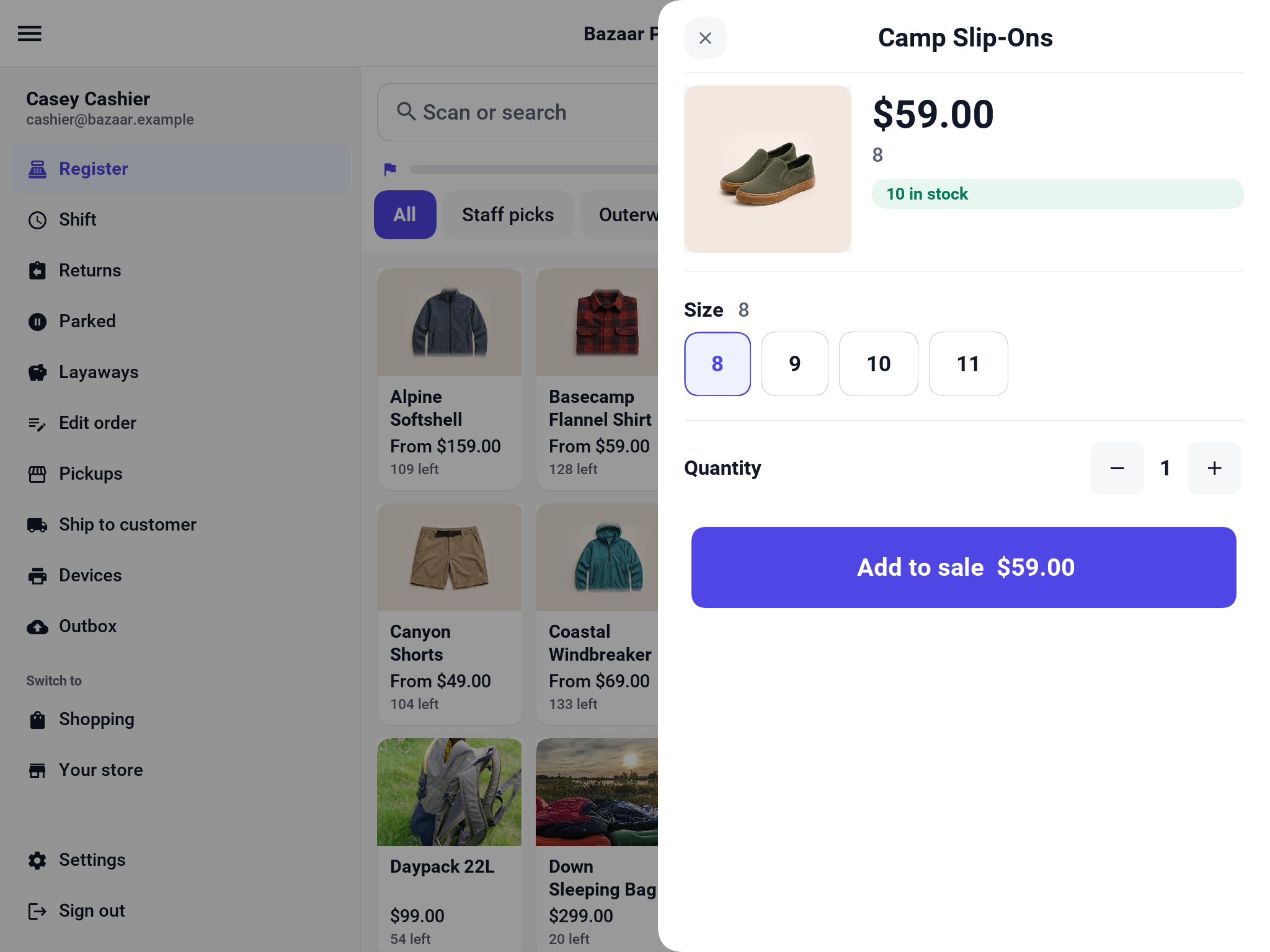
Fulfilment
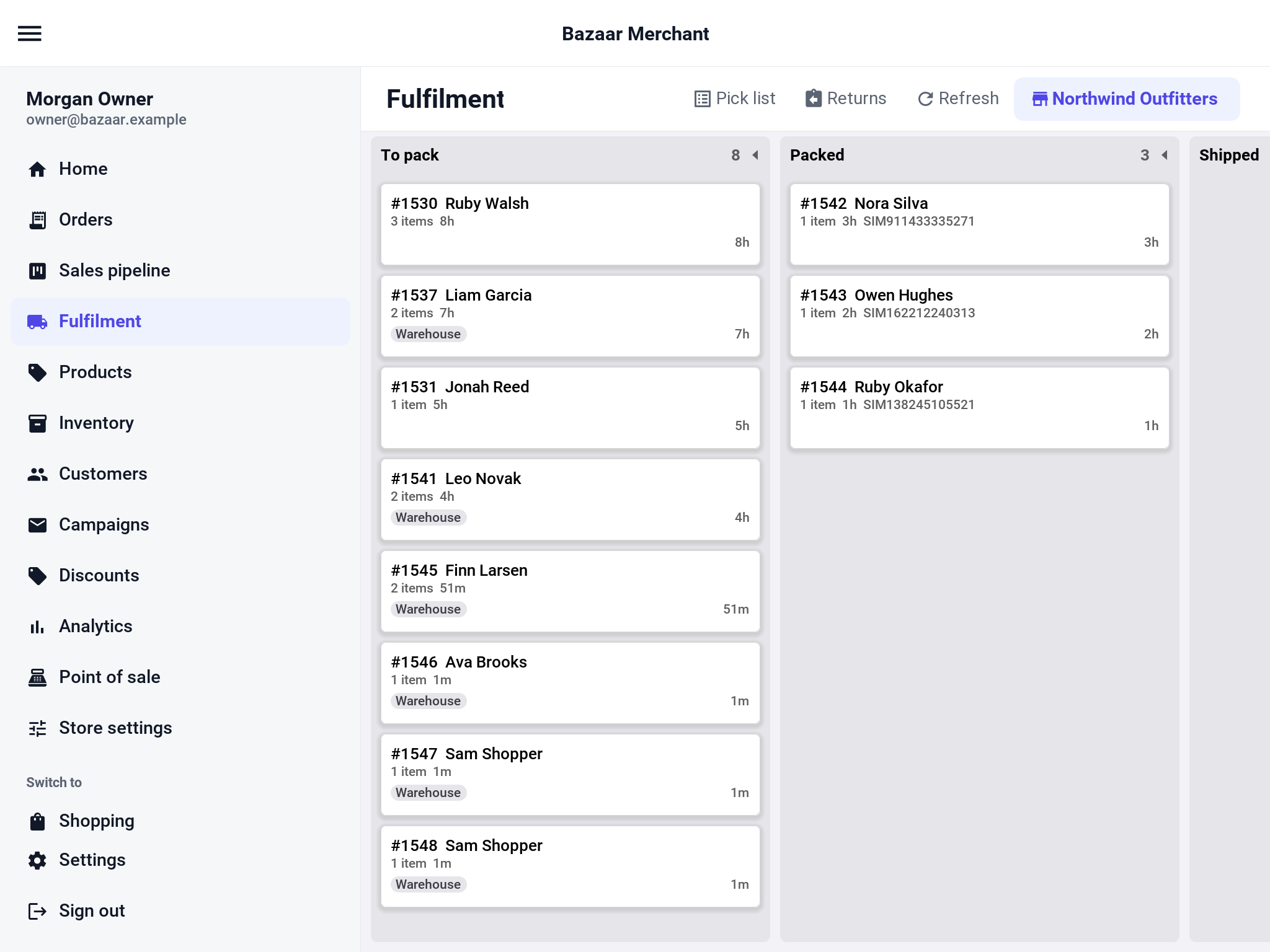
The merchant’s fulfilment board shows every open order as a card in To pack,
Packed, Shipped, or Delivered. On a wide screen it’s a KanbanBoard: dragging a
card one column to the right does what that column means on the server (packs
it, buys the cheapest label and ships it, or marks it delivered), and any other
move is put back. On a phone it shows one column at a time, with a button on each
card that moves it on. The live channel reloads the board when an order changes. The pick
list for the cards in the first column is made on the device, with the same
com.codenameone.pdf package the server renders invoices with:
/// Builds the pick list for `orderIds` out of `queue` (every queued order
/// when null).
///
/// @param heading the store and the column, for the title
/// @param printed when it was made, already formatted
static byte[] build(String heading, String printed, List<UnfulfilledDto> queue,
        Collection<String> orderIds, java.util.Map<String, String> locationNames)
        throws IOException {
    PickListPdf p = new PickListPdf();
    p.doc.setTitle("Pick list").setCreator("Bazaar");
    List<Fulfil.PickLine> lines = Fulfil.pickList(queue, orderIds, locationNames);
    p.newPage();
    p.text(PdfFont.HELVETICA_BOLD, 20, INK, "Pick list", MARGIN);
    p.y += 22;
    p.text(PdfFont.HELVETICA, 10, MUTED, heading + "  -  " + printed, MARGIN);
    p.y += 14;
    p.text(PdfFont.HELVETICA, 10, MUTED, Fulfil.units(lines) + " units, " + lines.size()
            + " lines", MARGIN);
    p.y += 22;
    p.table(lines);
    p.orders(queue, orderIds, locationNames);
    return p.doc.toByteArray();
}
Sales pipeline, insights and the merchant AI
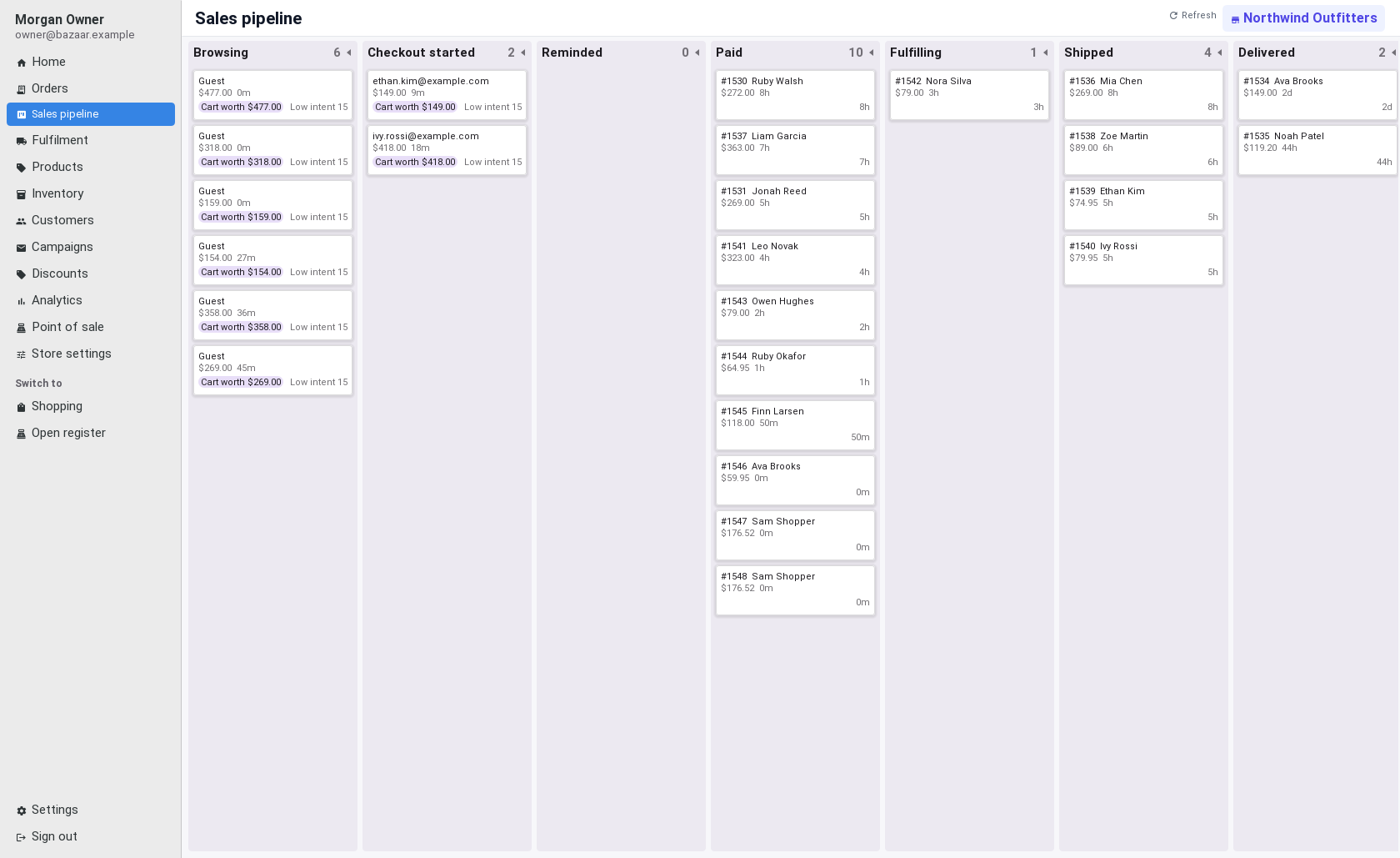
The sales pipeline (pipeline/Pipeline, PipelineApi) is worked out, never
stored. A cart with lines that was touched in the last 30 days is Browsing, or
Checkout started once it has an email or an account to write to, and Reminded
once its recovery mail went. Orders take their column from the fulfilment
board, and an open return moves an order to Return requested. The legal moves
live in the shared ops/SalesPipeline, which the app checks before a drop and
the server checks again. Checkout to Reminded claims the cart’s reminder the
way the abandoned-cart sweep does, so the mail goes once whichever sends it;
the order moves call Fulfillments.moveCard. Each column pages by 20 cards.
Product views are recorded one row per view in product_view_event, keyed by
the cart token or the account, from both the storefront and the app’s catalog
API. Those rows give the purchase-intent signals (views, visits split at a
30-minute gap, minutes between views in a visit) that SalesPipeline.score
turns into 0 to 100, and the views step of the insights funnel. An order’s
source column tells a website checkout from an app one, so
Analytics.insights can split the channel mix with one grouped query.
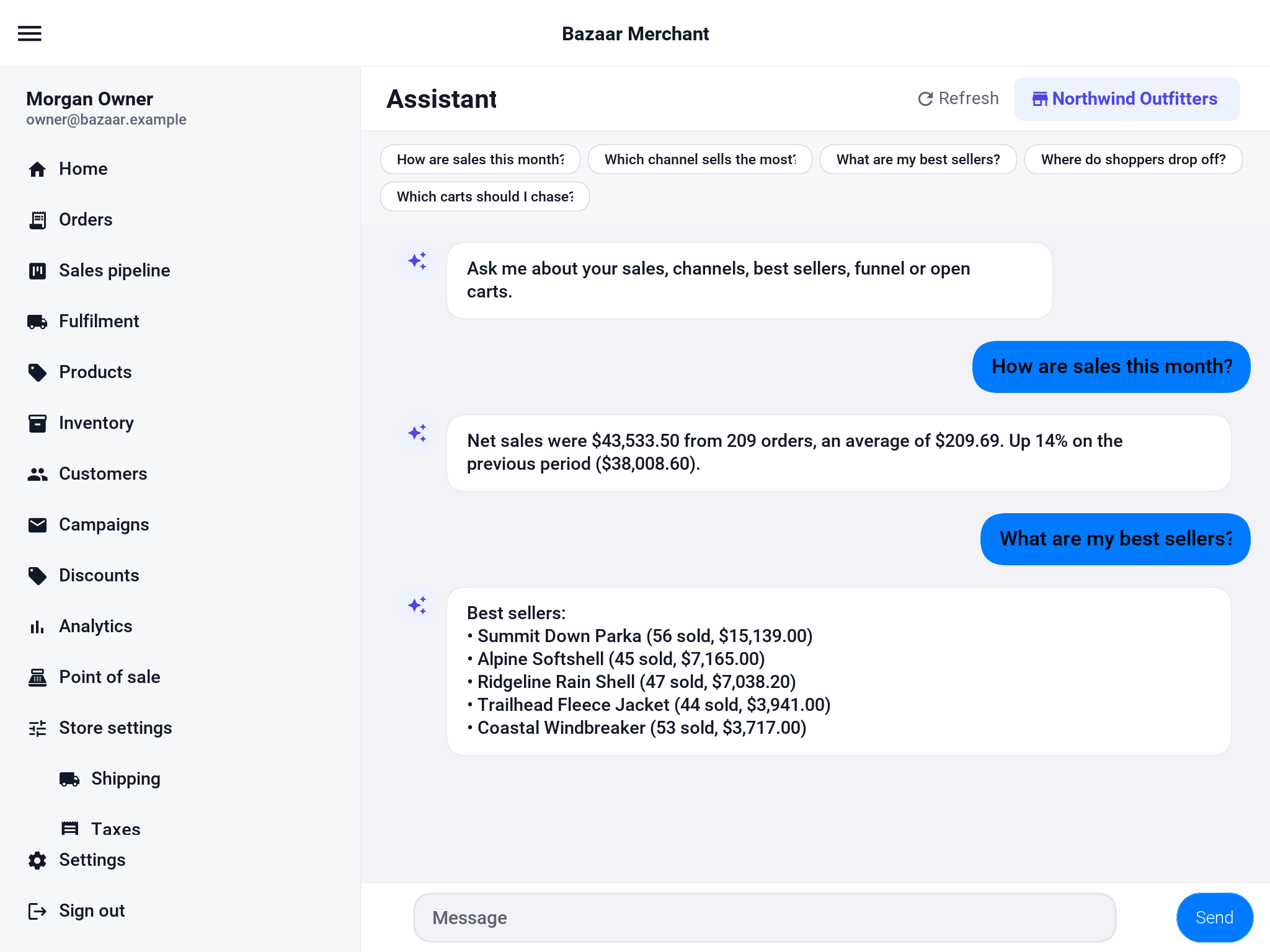
The merchant AI uses com.codename1.ai in the app and keeps the key on the
server. The app makes an OpenAI-compatible client with
LlmClient.localOpenAiCompatible pointed at
/api/merchant/stores/{storeId}/ai/v1, with no key: the session’s bearer token
authorizes it. MerchantAiController accepts only a first system message of
bazaar:assistant or bazaar:description, replaces it with the server’s own
instructions, fixes the model and the reply length, and forwards to the
configured provider:
# openai, anthropic, gemini, or url
bazaar.ai.provider=openai
bazaar.ai.key=...
# optional; each provider has a default
bazaar.ai.model=gpt-4o-mini
# for "url": any OpenAI-compatible server
bazaar.ai.url=
The assistant’s tools (AssistantTools) run in the app over the dashboard,
insights and pipeline it already fetched; the model calls them and
AssistantRun sends the results back until it answers in words. Every tool
result carries a summary sentence. With no provider, AiFallback answers in
the same response shape: it picks the tool a question’s words point to, then
answers with the tool’s summary, and drafts descriptions from the product’s
fields. The tests run against that fallback.
Profiles, routing and fulfilment services
A shipping zone may belong to a shipping profile; ShippingCalculator prices
each profile’s lines against that profile’s zones and adds the matching
options up, so a mixed cart pays the sum. Line locations come from
routing.OrderRouting, which feeds the store’s rules to the pure
routing.Router: locations that hold a line’s units always come first, and
each rule only breaks the ties the earlier ones left. Without rules, the first
location in the store’s order that holds a line’s units ships it.
A third-party warehouse is a routing.FulfilmentService: submit hands it an
order’s lines at the location it runs, and status reports what it has done.
ThirdPartyFulfilment polls on a schedule under a cluster lock, records every
hand-over once in fulfilment_service_order, and turns a shipment into an
ordinary fulfilment, so the shopper’s mail and the orders/fulfilled webhook
come from the usual path. A real integration replaces
SimulatedFulfilmentService with calls to the warehouse’s API.
CarrierProvider.buyReturnLabel buys a return label; EasyPost marks the
shipment is_return. ReturnLabels calls it when a return is approved and
never fails the approval: without a label the shopper is told to send the
parcel back themselves.
Documents on the server and on the device
The PDF package is shared with the backend, so the server renders invoices,
packing slips, shipping labels with a Code 128 barcode, purchase orders, credit
notes, shift reports and receipts with the same API the app uses. Each is a
GET under the store’s merchant routes ending in .pdf; a shopper gets the
invoice for their own order from /api/orders/{orderId}/invoice.pdf. The app shows
them with the PDF viewer, prints them where the platform has a printer, shares
them, and on a desktop lets the user drag the file out of the window.
Webhooks
A store can register addresses to be told about orders/create, orders/paid,
orders/fulfilled, orders/cancelled, refunds/create, inventory/low,
products/update and customers/create. Every delivery is a POST of the event
as JSON with an X-Bazaar-Timestamp header (seconds since the epoch), signed
with the webhook’s secret over the timestamp, a . and the body in the
X-Bazaar-Signature header. A receiver computes the same value over the exact
bytes it received, compares the two in constant time and refuses a timestamp
more than five minutes from its own clock before trusting the body:
public static String signature(String secret, long timestamp, byte[] body)
        throws IOException {
    byte[] prefix = (timestamp + ".").getBytes("UTF-8");
    byte[] message = new byte[prefix.length + body.length];
    System.arraycopy(prefix, 0, message, 0, prefix.length);
    System.arraycopy(body, 0, message, prefix.length, body.length);
    return "sha256=" + Ids.hex(Crypto.hmacSha256(secret.getBytes("UTF-8"), message));
}
A delivery not answered with a 2xx status is retried after 1, 2, 4, 8 and 16 minutes, and is marked failed after six attempts. The merchant's webhooks page lists every delivery with its status and response, and can send one again.
Apps subscribe to the same topics with their own tokens, and their deliveries are signed with a key derived from the app’s client secret; Webhooks describes that side.
Automations
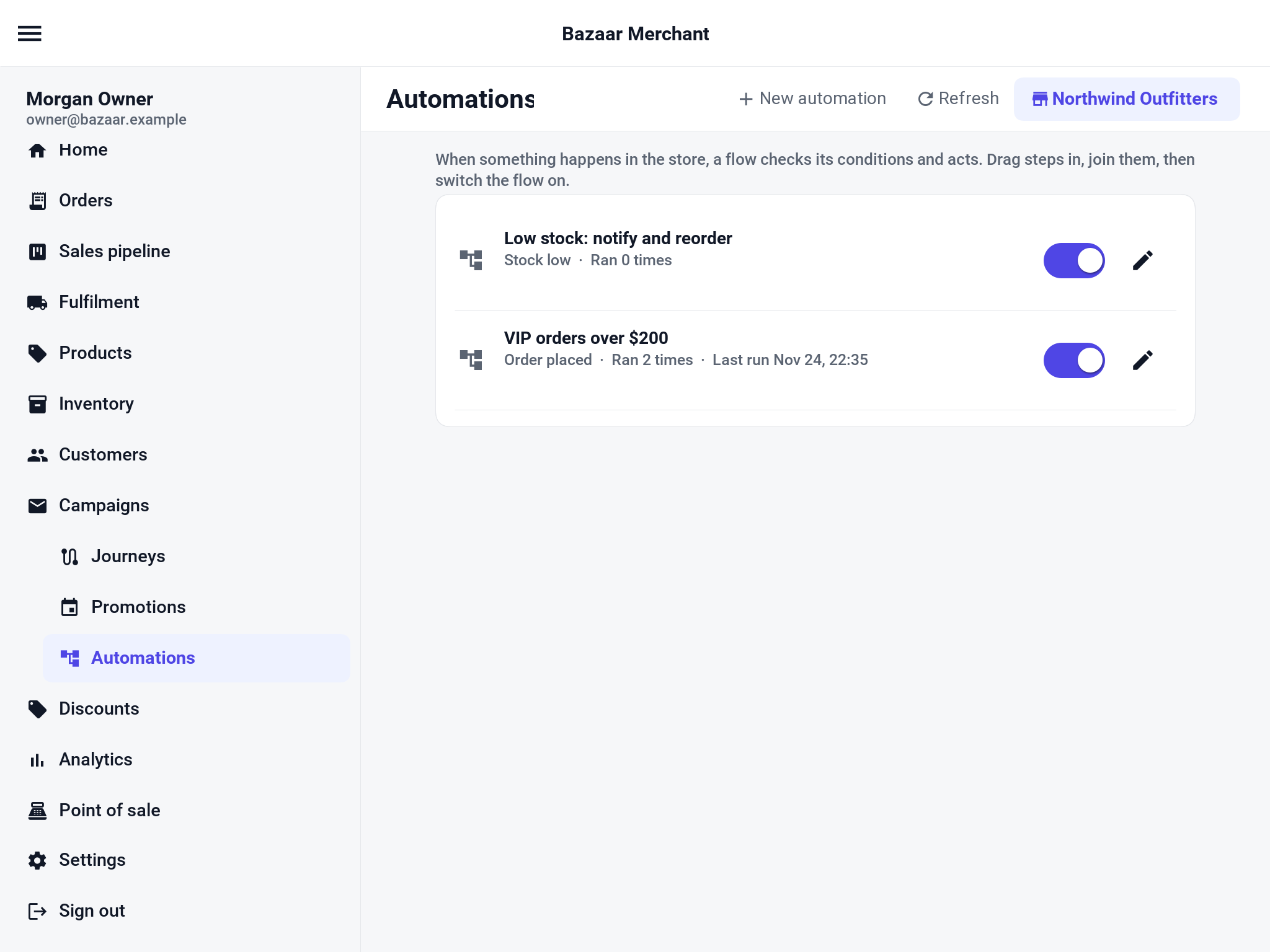
An automation is a graph drawn in the app’s NodeGraph editor and stored as JSON
in Automation.graphJson. Each node is a trigger, a condition or an action. A
node’s data is a map of its parameters with its type repeated under type, and
every value is kept as text, whole numbers for money and counts. Ports are named
in, out, yes and no:
@Override
public Object encode(Object userData) {
    if (!(userData instanceof Map)) {
        return null;
    }
    Map<String, Object> out = new LinkedHashMap<String, Object>();
    for (Object e : ((Map<?, ?>) userData).entrySet()) {
        Map.Entry<?, ?> entry = (Map.Entry<?, ?>) e;
        if (entry.getKey() != null && entry.getValue() != null) {
            out.put(entry.getKey().toString(), text(entry.getValue()));
        }
    }
    return out;
}
The server’s NodeCatalog is the list of node types, which the editor reads to
build its palette, so a new type needs no app release. Each entry names its
kind, title, description and parameters:
trigger(all, ORDER_CREATED, "Order placed", "An order is placed online or at a register.");
trigger(all, ORDER_PAID, "Order paid", "An order's payment is taken.");
trigger(all, ORDER_FULFILLED, "Order fulfilled", "The last item of an order ships.");
trigger(all, INVENTORY_LOW, "Stock low",
        "A sale takes a variant to its reorder point or below.");
trigger(all, CUSTOMER_CREATED, "New customer", "A shopper orders for the first time.");
trigger(all, CART_ABANDONED, "Cart abandoned",
        "A cart with items and a shopper to reach sat untouched for an hour.");
condition(all, IF_TOTAL_OVER, "Total over", "The order's total is over an amount.",
        param("amount", "Amount", "MONEY", "20000"));
The full set:
| Kind | Types |
|---|---|
Trigger |
|
Condition |
|
Action |
|
AutomationGraph parses a graph and says what’s wrong with it: no trigger,
triggers of more than one kind, an unknown type, a connection to a missing step
or a port the step lacks, or a connection into a trigger. An active automation
must validate before it’s saved; an inactive one is a draft and may be
incomplete. When an event fires, after the change that fired it has committed,
the engine walks the graph from the matching trigger, following yes or no at
each condition, and performs each action in turn. Every action leaves an audit
event, which is the automation’s activity log, and an automation that fails is
logged without undoing the change. A wait.minutes node stores the rest of its
branch as a run that resumes when the wait is over.
The development profile seeds two examples in every store: tagging
orders over a set amount as VIP, and notifying staff and drafting a purchase
order when stock runs low.
A storefront search engines can read
web/StoreSite adds the storefront’s search and launch surfaces: /s/<handle>/suggest
(prefix matches from Catalog.suggest, filled into the search box’s datalist
by /suggest.js), the pre-launch page behind Store.storefrontPassword (a locked
store leaves the sitemap and gets a robots.txt Disallow), and
/s/<handle>/embed/<product>, the one page that sets its own policy with
frame-ancestors *. Synonym groups (Store.searchSynonyms) widen each search
word in Search.matches, and Product.searchBoost is added to the relevance score.
The app’s search field asks the same endpoint through CatalogApi.suggest, after
the typing pause, and SuggestGate drops any answer a newer request outran.
Store.customDomain (unique, validated and folded by SiteUrls.domain) is a
store’s own hostname. SiteUrls.storeForHost matches the Host header against
it, Storefront maps /, /collections/, /products/, /search and /cart on
that host onto the /s/<handle> handlers, and StorefrontFiles answers that
store’s own robots.txt and sitemap.xml. SiteUrls.absolute addresses those
pages as https://<domain>/…;, so canonical links and structured data follow.
Other hosts see the platform as before.
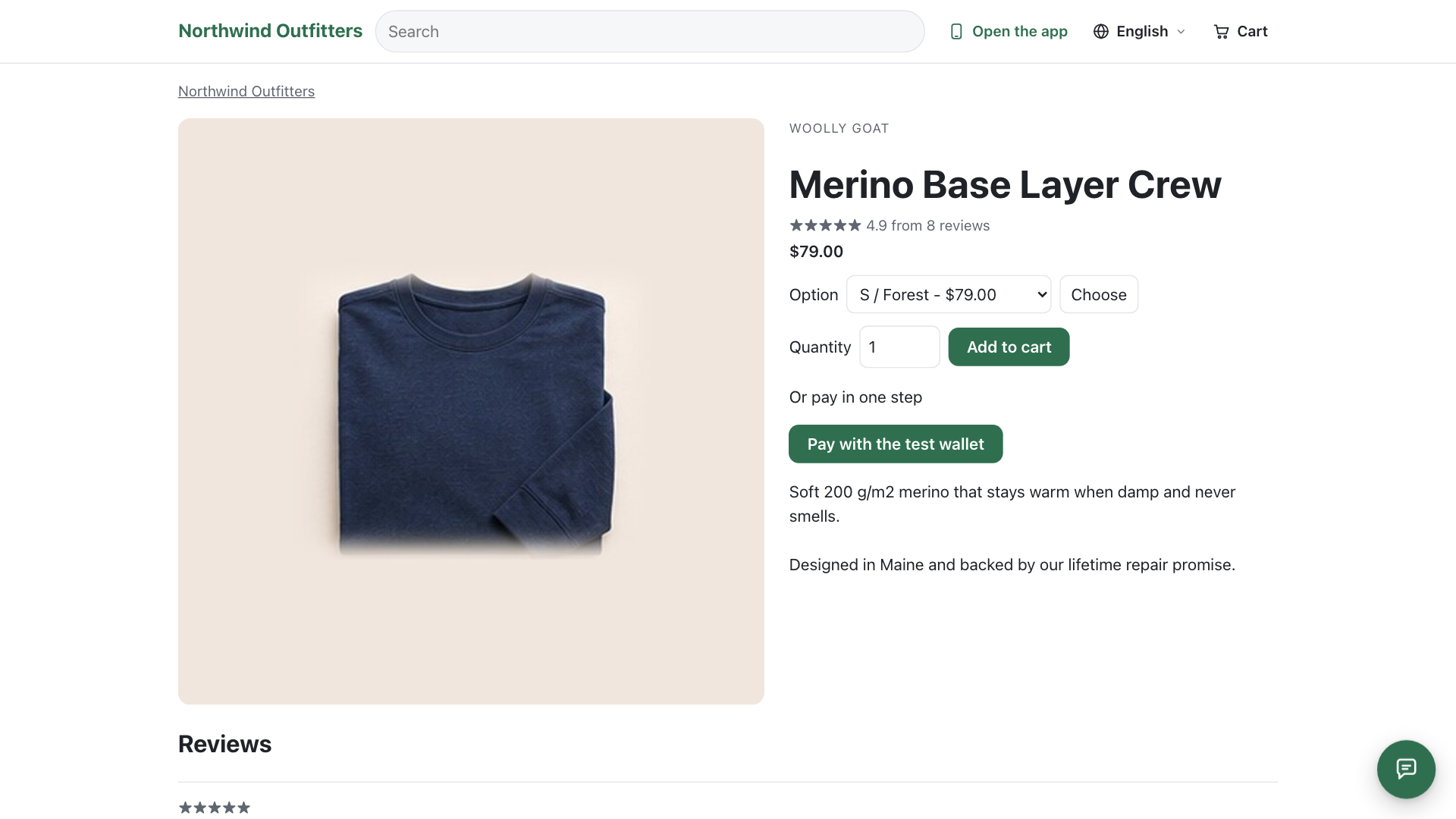
The app is a Codename One application, and a crawler that doesn’t run
JavaScript sees nothing of it in a browser. The backend therefore also serves
the storefront as server-rendered HTML, from templates in
backend/src/main/resources/templates: a store’s home page at /s/<handle>, its
collections, search, product pages, a cart that works with plain form posts, and
order tracking at /track/<number>.
Each page carries its title, description, a canonical link (also sent as a
Link header) and link preview tags. /robots.txt keeps the API, the sign-in
pages and the per-visitor pages out of indexes, and /sitemap.xml lists every
active store, published collection and active product with when it last changed.
Pages that are the same for every visitor are sent with
Cache-Control: public, max-age=60, stale-while-revalidate=600, so a cache in
front of the server can absorb a crawl. Checkout runs on the same pages; see The web application.
The web application
The server renders two things for a browser: the storefront with its checkout
and the shopper’s account, and the Bazaar app itself, whose JavaScript build it
serves at /app/. The back office in a browser is that app, the same one that
runs on phones, tablets and desktops, calling the same REST API; the server
renders no back-office page, and an old /admin or /platform address
redirects to /app/. The page code is under
backend/src/main/java/…/bazaar/web: account (the shopper’s account), commerce (its
company, quote and subscription pages), auth (sign-in and sign-up), slots (app slots and consent), table (CSV cells for
exports) and security. Pages are compiled templates; small interactions, such
as refreshing delivery rates, use htmx and fall back to a plain form post. Every
page calls the same services the app’s REST endpoints call, so a rule is
enforced once.
Security. WebSecurity adds three filter chains beside the app’s own:
fingerprinted assets under /static/** cached as immutable; signed-in pages with
a session cookie, CSRF tokens, session id rotation at sign-in, an optional TOTP
second step, sign-out by POST only, and rate limits per address plus a lockout per
account and address, with looser ones per address across accounts and per
account from every address (Throttle). Anyone can trip the per-account one by
failing on purpose from enough addresses, so it refuses only browsers that never
signed in to the account: each successful sign-in sets a year-long, HttpOnly,
SameSite=Lax known-device cookie (Secure when HSTS is on), an HMAC of the
account under a server secret, and an attempt carrying a valid one for the
account it names skips that rule while still meeting the other two
(KnownDevices). The third chain is the public storefront, and a fourth answers an old /admin or /platform address with a redirect to /app/. Signed-in
pages carry a
per-request CSP nonce. Public pages carry none, so they can be cached: their one
inline style is allowed by its hash, which the build writes into InlineHashes.
ErrorPages answers every failure, including a CSRF refusal or a rate limit, with
a constant page that echoes nothing of the request. Uploads sniffs an image’s
format from its bytes, caps size and dimensions before decoding, and keeps only
the re-encoded pixels. UrlGuard refuses webhook targets on private or loopback
addresses.
Bot guard. BotGuard protects sign-in and placing an order without a
third-party CAPTCHA: a hidden honeypot field, a form timestamp signed with the
forms signing key (bazaar.forms.signing-key) that must be older than bazaar.bot.min-fill-ms and younger
than six hours, and the throttle.
App slots. Slots lets the store owner, and only the owner, from the app’s
back office, place script snippets and widgets at named places of the storefront. A page widens its CSP by
exactly the hosts of the snippets it prints, never a wildcard or
'unsafe-inline', and mixes the slot version into its ETag. A widget’s HTML is
framed from /w/{id} in a sandbox, never in the storefront’s origin. Each slot
names a consent category, and Consent (the bz_consent cookie) decides whether
it loads. Every edit is audited.
Checkout. /s/{handle}/checkout calls Checkouts.place with an idempotency key
from the page, so a double submit places one order. The confirmation page opens
for the account that placed the order, or with a link token derived from the
order, which is how a guest returns to it. A cart reminder links back with a
recovery token that Carts.recover turns into that cart in the new session.
The online store
The content package holds what a merchant edits about the storefront itself:
Themes: a draft and a live theme. Every value is a key from a safe list or a checked#rrggbbcolor, mapped to classes inweb-src/shop.css, because the public pages allow no inline style; nothing a merchant types reaches CSS. A preview is an address signed with the store and an expiry, valid for an hour. Home page blocks live on the theme row (blocks, one a line, kind, text and reference split by tabs), so a draft’s blocks publish with the rest of it. A button links only to a site path or anhttpsaddress and an image only to one of the store’s photos; a product or collection that’s gone drops its block when the page renders. The app reads them from/api/shop/stores/{handle}/blocks.Platform.organization: the stores an owner owns (Store.ownerUsername), with counted orders and sales less refunds, behind/api/merchant/organization.PagesandRichText: pages, the four policies and blog posts, sanitized when saved, so what’s stored is already clean.Navigation: themainandfootermenus, two levels deep, and the redirect table.web.StorefrontRedirectsfollows a redirect only where the storefront would answer 404, so a redirect never hides a live page, and only within the store named in the path. Chains and loops are refused when saved.Metafields: typed fields on products, variants, collections, customers and orders, and metaobject types whose entries a field can reference. Values are checked when written and stored as text plus a number, so they sort without parsing.
web.StorefrontFeeds serves product feeds per market as Google Merchant RSS and
CSV, priced exactly as that market’s storefront, and the blog as Atom and RSS,
each with an ETag. web.StorefrontMarkets chooses the market from ?market=
(a cacheable address of its own, advertised with hreflang) or the shopper’s
cookie (which makes the page private), and the language from the market or
Accept-Language.
Storefront text and languages. The storefront’s own text (buttons, cart,
checkout labels and errors, the consent banner, chat, sign-in and sign-up,
and the signed-in account pages: orders, returns, addresses, wishlist,
reviews, loyalty, subscriptions, two-step sign-in and the company buyer’s
quick order, quotes and invoices) ships in English, Spanish, French, German
and Hebrew, generated into web.StoreText from backend/storetext.py.
Hebrew pages are drawn right to left. A language picker on every
storefront and account page posts to /lang and keeps the choice in a
lang cookie; the choice comes first, then the market’s locale, then the
browser’s Accept-Language, then English. A page drawn from the cookie is
the shopper’s private copy, every shared page says Vary: Cookie, and each
language also has an address of its own (?lang=fr) that crawlers find as
an hreflang alternate. Messages that come from the services (validation errors, refusals)
arrive in English. Shopper mail, SMS and push follow the shopper
(notify.ShopperLanguage): the order and the cart record the language they
were placed or filled in (the storefront’s resolved language, or an API
client’s Accept-Language), the store’s customer record keeps the
language of the last order, and the account keeps the language it signed up
in, the one picked on the storefront while signed in, or the one the app
sends with its settings (the device’s, when the shopper never picked one).
A message uses the order’s language, then the customer’s, then the
account’s, then the language of the store’s first market, then English;
Hebrew mail is drawn right to left. That covers the order confirmation,
shipping and delivery notices, review requests, returns and refunds,
receipts, cart reminders, gift cards, back-in-stock alerts, signup
confirmations and codes, phone verification codes, shipment pushes and the
till receipt texted from the POS (the till’s own copy stays English).
Text a merchant writes can be translated per language. A campaign’s
subject, A/B subject and body are translations of kind CAMPAIGN
(market.Translations), edited on the back office’s translations page
(linked from the campaign) and in the app’s campaign editor; a campaign’s
translations never decide a storefront’s language. A journey or automation
message step keeps its translations in the step itself, as body@es beside
body, edited in the app’s journey and automation editors and, for
journeys, on the back office journey page. The reader gets their language’s
version only when every text the message needs is translated (body, plus
that recipient’s A or B subject for e-mail), else the whole original, so a
translated body never goes out under an untranslated subject; the frame
(the unsubscribe link, the default subject, the page direction) follows the
shopper either way. Staff messages (the low-stock mail, automation pushes to
staff) follow the staff member’s account language, else English; the
store’s own address gets English.
Markets, tax and risk
market.Markets prices a variant for a market from a fixed price, or else the
store price at the merchant’s own exchange rate plus an adjustment in basis
points, rounded as the market asks, all in integers. Every amount is a whole
number of its currency’s minor unit, with the number of decimals taken from
java.util.Currency.getDefaultFractionDigits(): cents for dollars, yen for
yen, fils for Bahraini dinars. ops.Amounts (in the shared module) formats,
parses, rescales and converts them; columns and fields named …Cents hold
minor units of the order’s or store’s currency. The Fennel & Fig demo store
sells in yen. When a shopper checks out in a market, prices are
worked out in the store’s currency and the amount due is converted at the rate
the page showed, locked for the order. The order keeps both its totals in the
store’s currency and the presentment currency, total and rate, and refunds go
back in what was charged. market.Translations answers each field from the exact
locale, then its language, then the original. Product text is translated where
it’s shown, by market.ProductText, never where it’s stored: an order line
and the merchant’s editor keep the original, and cart, checkout, order pages and
mail translate the line’s name in the order’s language. Option ids change on
every product save, so OPTION translations are keyed by the product and the
option’s position (name1, values1), and a values translation applies only
when it has as many values as the original. Each translation stores a hash of
the original it was made from (source_hash); a different hash today is what
the sheet calls outdated. The storefront’s interface text
(web.StoreText, read in templates as ${page.t['key']}) follows the market’s
language when there is text for it, else the visitor’s Accept-Language, and
falls back to English key by key; a Hebrew page is drawn right to left. A page
whose language came from the header says Vary: Accept-Language, and a
market’s copy has an address of its own, so a shared cache never serves one
language for another. Duty estimates come from customs
codes and the longest matching prefix in the merchant’s duty table.
taxes.TaxExemptions removes tax from a quote to a region a customer’s
certificate covers, and records the certificate on the order for the tax report.
A store whose prices include tax refunds the tax portion instead, so lines and
totals still agree.
taxes.TaxRules applies, in order, a product’s override, its collection’s, the
EU VAT table for the product’s tax category when the store has EU VAT on, and
the United States provider for an address in the United States. The VAT table (vat_rate, seeded by
migration) is data, not code: rates change, and keeping them current is the
operator’s job. The OSS report sums goods lines by country and rate from the
rate each line was charged; shipping keeps the cart’s own rates and isn’t in
it. United States sales tax goes through taxes.SalesTaxProvider; the sample ships
SimulatedSalesTaxProvider with a few state rates. A production store
implements the interface over a real service such as Avalara, TaxJar or Stripe
Tax, adds it to the providers listed in the TaxRules constructor, and picks
its name in the store’s tax settings. A provider that can’t answer returns -1, and the store’s
own rates apply.
staff.StaffSecurity, staff.SsoProviders and platform.StoreApiKeys cover
staff sign-in and machine access. Two-factor codes are TOTP with recovery codes,
and a store that requires them refuses staff who haven’t enrolled. Single
sign-on is OpenID Connect with PKCE; the ID token is checked against the
provider’s JWKS, the email must be verified, and its domain picks the role. An
account owned by one store’s provider can’t be added to another store. API
keys are 256 random bits, stored only as SHA-256 hashes and found by that hash;
only their prefix is shown again. platform.BulkJobs runs export and import jobs
in the background and puts a job left running by a stopped server back in the queue.
risk.Fraud scores each online order once its payment is held: order value,
velocity, recent refused payments, an unusual delivery country, and a mismatch
between delivery country and the client’s country, read from a header a trusted
proxy sets (bazaar.risk.country-header). Sixty points or more holds the order,
and RiskHolds makes fulfilment refuse it until a manager approves or cancels.
No single signal holds an order. The merchant’s own rules (fraud_rule,
migration V180, RiskApi fraud-rules) run in the same Fraud.assess: a
HOLD match holds the order like a high score, a CANCEL match cancels it with
Orders.cancelOrder. The per-hour rule counts the signed-in customer, since
orders keep no client IP. An outside risk service plugs in as a
risk.RiskProvider (bazaar.risk.provider, none by default): its score is
added to the points and its reasons are listed with the others, so a high
score holds the order for review. A provider that can’t be reached adds
nothing and never blocks checkout.
A custom domain is served, and named in canonical links and the sitemap, only
once the store proves it owns it (web.DomainVerification, DomainApi).
Claiming a domain issues a token, published either as a file at
/.well-known/bazaar-verify/<token> on the domain or as a TXT record
bazaar-verify=<token> on _bazaar-verify.<domain>, looked up over
DNS-over-HTTPS (bazaar.domains.doh-url). A domain another store has proved
can’t be claimed.
The bot guard’s and the theme preview’s signing keys derive from one secret,
bazaar.forms.signing-key (BAZAAR_FORMS_SIGNING_KEY, at least 32
characters), given the same on every server. Without it each process makes a
random key and logs a [config] warning on a development profile, an error
on any other.
A company whose VAT id VIES confirmed, buying from a store with an EU home
country for delivery to another member state, is reverse charged
(taxes.ReverseCharge): the order carries no VAT, records the VAT id as its
exemption, and the invoice prints the reverse-charge note. Manual tenders online are two rows of
PaymentTypes (cod, bank_transfer) that open no processor intent: the
order is placed PENDING and Orders.markPaid settles it. dispute.Disputes takes the processor’s signed,
idempotent webhook events and moves a dispute from needs-response through review
to won or lost, refusing evidence after the deadline.
Marketing, subscriptions and B2B
The jobs in these packages share one pattern: each step is a conditional update on the state it starts from, so a restart or a second server never repeats one.
marketing.Campaignswrites one send row per consenting member of a segment, claims each before it sends, and runs an optional A/B subject test before sending the winner to the rest.marketing.Audiencesbuilds a segment’s SQL from a fixed list of rules. Consent is a row per customer and store; a confirmed signup sets it and unsubscribing clears it.journey.Journeyskeeps one enrollment per customer and journey pointing at its next step, and counts the customers passing each node for the flowchart.loyalty.Loyaltyrecords every movement of points in a ledger whose reference is unique per store, so an event told twice moves nothing.club.Clubsderives each renewal’s charge id from the member and period, so a renewal run twice charges once.sale.SaleEventssnapshots the prices a sale replaces and puts them back when it ends.subscribe.Subscriptionscharges the first delivery and every renewal the same way, retries a failed renewal after one day and then three, and pauses on the third failure. Resuming starts a fresh schedule.trade.Tradecovers companies, price lists with quantity rules, quotes and net terms;trade.LineOrdersplaces orders priced by the caller, reserving stock all or nothing.trade.VatIdschecks the format of EU VAT numbers only.
Pre-orders are decided in cart.Quoter: a line short of stock on a variant that
allows pre-orders is sold ahead of stock and reserves nothing, counted against
the variant’s pre-order allowance.
Customer data, credit and automatic mail
Merge and erasure live in
customer/CustomerData. A merge moves every row keyed by the duplicate’s id through each repository’smoveCustomerquery, and the account rows (reviews, wishlist, product views) by username, then deletes the duplicate and writes aCUSTOMER_MERGEDaudit event. Erasure blanks personal fields on the customer and its orders but never an amount, so the books still add up.Exports are a zip of JSON files built in memory:
customers.json(the store’s records) andaccount.json(the account’s own rows).Store credit is a ledger of grants (
store_credit_grant) and uses (store_credit_use). The customer’sstoreCreditCentsis a cached sum. The pure arithmetic is incustomer/CreditMath: grants are spent in order of expiry, never-expiring ones last. A refund puts credit back on the grants it came from.Bulk codes (
rates/DiscountCodes) are copies of a discount with a usage limit of one andbatchIdset, hidden from the discount list and deleted with it.Automatic mail is in
marketing/MarketingMails, on scheduled jobs. Browse mail is decided byshouldMail(an hour of quiet, a day at most, a week between mails). Review requests are rows written at delivery and sent when due, withbazaar.reviews.requestDaysas the delay. Gift cards with a futuredeliverAtgo out fromGiftCards.deliveryJob. Each send claims its row with a conditional update first, so two instances never mail twice. The review link and the browse unsubscribe link are HMAC-signed with the store’s campaign secret. The review page only displays on GET; the POST writes.
Operations and the register’s tools
The ops package holds the warehouse board (Warehouse, stage moves checked by
WarehouseFlow and made conditionally), transfer and purchase order timelines
(Timelines, written by Stock), forecasts (Forecasts, whose drafts go through
Stock), the report builder and cohorts (Reports, where every dimension and
metric is matched against a fixed list and never written into SQL; profitLoss
sums net sales, refunds through merchandiseRefund and cost of goods from the
variant’s current cost_cents, since an order line keeps no cost; no processor
fees are recorded, so there is no fee line), "frequently bought together"
(Catalog.together, co-purchase counts over paid orders, then the product’s
collections, and only products the shopper could open), UTM and
referral attribution (Attribution, first and last touch carried from the landing
page through the cart to the order, held in the session only when there is a
touch so plain visits stay cacheable), permission sets (Permissions, per area
and per location; the owner is never restricted), the chat inbox (ChatInbox,
rate limited before anything is stored or mailed; the floating storefront chat
reaches it over /ws/chat, where ChatSocket takes a single-use visitor
ticket from POST /s/<handle>/chat/session or a staff LiveTickets ticket,
re-checks the inbox rights on every frame that names a conversation and refuses
handshakes from other origins; ChatLive keeps the connections, presence and
WebRTC call signalling in memory, with STUN from bazaar.ice.stun and TURN
credentials minted per connection from bazaar.ice.turn, bazaar.ice.secret and
bazaar.ice.ttl) and combined listings with
marketplace import (Listings, which validates every row before making any
product).
The merchant app’s inbox (merchant.InboxPane) joins the same socket as one
more member of staff: ChatChannel asks for a LiveTickets ticket over the
authenticated API and connects with ?staff=<ticket>&store=<id>, so the app
and the web inbox share conversations, presence, and calls. The REST list gives
each conversation an unread count (shopper lines newer than the staff read
mark), and the open thread sends seen with the newest message’s server time.
An incoming call is answered with Codename One’s WebRTC package
(com.codename1.webrtc): ShopperCall holds the signalling (it keeps the
offer and the shopper’s early candidates, and sends its own candidates only
after the ANSWER that claims the call, since the server drops them before),
and RtcMedia builds the peer connection from the ICE servers in the socket’s
hello frame. Candidates travel as {candidate, sdpMid, sdpMLineIndex}
objects, the shape a browser’s toJSON() makes.
STUN alone connects most calls; behind symmetric NAT or a strict firewall a
call needs a TURN relay. Run one with a shared secret (coturn’s
use-auth-secret and static-auth-secret) and set bazaar.ice.turn to its
URLs (comma separated, for example turn:turn.example.com:3478?transport=udp
and a turns: URL on 443), bazaar.ice.secret to the same secret, and
optionally bazaar.ice.ttl to the credential lifetime in seconds. Browsers
and the app then receive time-limited TURN credentials per connection; the
secret never leaves the server.
On the register side, pos.PosTools holds the store’s register policy (tip
presets, approval thresholds), commissions, manager approvals, parked carts and
the product grid. An approval is a manager’s PIN, checked with the sign-in
lockout, exchanged for a single-use approval id; the sale carries the id, never
the PIN, because it may wait offline. pos.Layaways keeps a layaway as an open
order with its units reserved, and order.OrderEdits recomputes totals and tax,
moves reservations and settles the difference.
The counter’s hardware and its links to the online store live beside it.
pay.CardTerminal is the reader interface, written after Stripe Terminal’s
server-driven integration: register a reader with its pairing code, create a
card_present PaymentIntent, hand it to the reader, then poll it (or take the
terminal.reader.action_* webhook through pay.PaymentEvents).
pay.StripeTerminal makes those API calls over the same transport as
StripePayments and needs bazaar.payments.stripe.terminal-location;
pay.SimulatedTerminal answers in development and tests, declining amounts that end
in 01. pos.CardReaders keeps readers per register and payments per register
clientId; a sale names the payment as its card tender’s reference, and the
payment is claimed with a conditional update so it pays one sale only. Refunds of
such a sale go back through the processor. A refund call that fails without a
definite answer fails closed: the payment stays REFUNDING and refuses another
refund, the order keeps its refund claims, and the timeline records
REFUND_UNCONFIRMED so staff settle the card leg at the processor. Each refund
sends an idempotency key derived from the charge, what was refunded before and the
amount, so asking for the same refund again never moves money twice. The app’s pos.EscPos builds ESC/POS
bytes (text, alignment, bold, size, cut, the ESC p drawer kick) and
pos.SocketPrinter writes them to the printer’s raw port with
com.codename1.io.Socket; both are plain classes behind pos.PrinterSink, so the
bytes are tested without a printer.
Checkout keeps a pickup rate only where its location has every stocked line on the
shelf (cart.Quoter), titled "Pick up at" the location. pos.Pickups is the
register’s queue of those orders; making one ready creates the pickup fulfilment
and marks it packed, which mails the shopper (Emails.pickupReady). A sale shipped
from the counter (PosSales.shipSale) is priced with the chosen rate and the
destination’s tax, stays open and unfulfilled with its units reserved at the
register’s location, and goes through fulfil.Fulfillments like an online order.
A counter sale records the seller’s commission rate on the order
(commission_bp), so the report in PosTools pays each sale at the rate of its
day.
Tests
mvn -pl shared,backend -Dcodename1.platform=backend test
mvn -pl shared,backend -Dcodename1.platform=backend test -Dcn1.backend.compiledTests=true
./run-e2e.sh
./run-web-e2e.sh
The first two lines run the server’s tests on the JVM and then compiled to a
native binary, which is how the server ships. run-e2e.sh starts a server and
drives the app’s real screens against it in the simulator; run-web-e2e.sh
builds the browser version, has the server host it, and drives it in a headless
browser.
Marketplace sync
The back office’s Channels page (and the app’s Channels section) connects a
store to a marketplace, lists variants on it and shows a per-channel sync log
and error state. channel.ChannelSync runs every 30 seconds: it pulls orders
(every two minutes, or at once when a notification arrives), pushes each listed
variant’s available quantity and price when it changed and held still for 20
seconds, and pushes shipments with their carrier and tracking. A pushed listing
carries listing-id:version as its idempotency key; a pulled order becomes one
MARKETPLACE order per external id, however often it’s replayed. A pulled
order the store can’t cover is still accepted, as an offline register sale is:
the units go below zero, the order and an audit event (CHANNEL_OVERSOLD) say
so, and every listing of the variant is pushed at once. Failures back off from
30 seconds to an hour and never touch checkout.
Marketplace notifications go to POST /api/channels/notifications?channel=ID,
signed sha256=<HMAC-SHA256 hex of the body> in X-Bazaar-Channel-Signature
with the secret entered when the channel was connected. An unknown channel and
a bad signature both get 401.
Every marketplace sits behind channel.MarketplaceConnector. Without
configuration every channel runs SimulatedConnector, an in-memory marketplace.
The eBay-style connector is enabled by the application’s credentials:
bazaar.channels.ebay.client-id=...
bazaar.channels.ebay.client-secret=...
# optional
bazaar.channels.ebay.api-base=https://api.ebay.com
bazaar.channels.ebay.identity-base=https://api.ebay.com
bazaar.channels.ebay.marketplace-id=EBAY_US
The seller’s refresh token, from the marketplace’s consent flow, is entered per channel; access tokens are refreshed and stored by the sync.
An order in another currency than the store’s is imported at the store’s rate for that currency, locked at import: the source an active market selling in it chose, otherwise the ECB feed when it has a rate, otherwise the merchant’s own rate. Lines, shipping, tax and total are converted to the store’s currency (half up, in integer millionths) for the books, and the order keeps the marketplace’s currency, its original total, the rate and the rate’s source, as a checkout in another market does. A refund of such an order records what goes back in the buyer’s currency at that locked rate. An order in a currency the store has no rate for is logged as an error, not imported.
Live services: Carrier, VIES, exchange rates and geolocation
Each of these talks to an outside service through a small interface, so the tests answer from canned replies and never reach the network. Each one is off, or simulated, until configured.
Carrier. bazaar.carrier.provider=easypost selects EasyPostCarrier, which
quotes rates, buys labels and tracks parcels through EasyPost’s API. It needs
bazaar.carrier.easypost.key and bazaar.carrier.easypost.webhook-secret;
with either missing, the server logs what’s absent and refuses to buy labels.
bazaar.carrier.origin.country, .postal, .city and .region give the
ship-from address. Point EasyPost’s tracker webhook at
/api/carrier/webhooks/easypost: the server checks the X-Hmac-Signature
header against the secret and records the scans the way polling does. Polling
stays on as a backstop, once per parcel every
bazaar.carrier.easypost.poll.minutes (30 by default). A bought label keeps its
printable URL on the shipment. Development profiles keep the simulated carrier.
A parcel whose destination country differs from the origin’s goes with
customs_info: one item per line with its HS code (the variant’s, else the
product’s), country of origin, quantity, value and weight, certified by the
origin’s name.
The same carrier prices checkout. A shipping rate of type CARRIER in a zone
asks the carrier, for the cart’s weight from the store’s first active location
that fulfils online orders to the shipping address, and offers one option per
service: the rate’s services field lists the services to offer (comma
separated, blank for all), the markup is added in proportion to the carrier’s
price (stored in basis points, rounded half up), and the rate’s price is a
flat handling fee on top. The REST quote, Checkouts and the web checkout share
this path. An option’s id is the rate id, ~, and the service code; placing an
order prices the chosen id again on the server, so a client names a rate and
never an amount, and an id the address wasn’t offered is refused. Quotes are
cached for ten minutes per cart, its contents, weight, origin and address, so
the form doesn’t call the carrier per keystroke. EasyPost’s requests give up
after eight seconds (three to connect), so a slow carrier costs a checkout that
long and no more. When the carrier fails, times out or isn’t configured, the rate offers its fallback price if it has one, and otherwise
nothing, while the zone’s other rates stand: a carrier outage never blocks
checkout. The simulated carrier’s rates are deterministic, and it refuses
postal code 00000 so the fallback can be seen in development.
VAT numbers. When a company is saved, the server asks the European
Commission’s VIES service whether its VAT number is issued, and stores the
outcome, the trader’s name and the date on the company. A number VIES says is
not issued is refused. When VIES or the member state’s service is down, the
company is saved as unverified and the next save asks again. Answers are
cached for bazaar.vat.cache-days days (7 by default); outages are never
cached. bazaar.vat.registry=none checks the format only, which is the default
under the test profile, and bazaar.vat.vies.url points at another endpoint.
Exchange rates. Each market chooses its rate source: the rate the merchant
enters, or the European Central Bank’s daily reference rates. A scheduled job
fetches the ECB file every six hours, converts each rate to millionths, and
derives the store’s cross rates in integer arithmetic. The merchant’s own rate
stays beside the feed’s, with the feed’s source and publication date, and every
order records which source priced it. bazaar.fx.feed=off stops the job, and
bazaar.fx.ecb.url names another copy of the file.
Platform totals. Every order records the rate from its store’s currency into
the platform’s reporting currency (bazaar.fx.reporting.currency, USD by
default) when it’s placed, and the platform console’s GMV converts at those
rates. The rates come from market.ExchangeRates: a fixed demo table by
default, or the European Central Bank’s daily reference rates with
bazaar.fx.reporting.provider=ecb.
Geolocation. bazaar.geo.trusted-headers lists country headers a CDN in front
of the server sets, such as CF-IPCountry, CloudFront-Viewer-Country or
X-Country-Code. The list is empty by default, because without a proxy that
overwrites them anyone can send those headers. bazaar.geo.ranges names an
optional CSV file of IPv4 ranges (first,last,country) loaded at start. The
storefront uses the country only to offer the matching market in a banner on
the product page. A ?market= link or the shopper’s market cookie always
wins, crawlers never see the banner, and the page’s address and canonical URL
stay the same. The fraud rule keeps its own header, bazaar.risk.country-header.
Apps
Third-party apps are separate services that a store’s owner installs, and
Extending Bazaar with apps is written for their developers. The code is in four
places. platform has the registration, the OAuth install (Apps,
AppOAuth, AppConsentPage), tokens and call limits (StoreApiKeys,
AppCallLimits, KeyApiOnly), the REST and GraphQL routes (AppResourceApi,
AppGraphQl, MiniGraphQl), the directory and billing (AppDirectory,
AppBilling). functions compiles, verifies and interprets checkout
functions (FunctionCompiler, Verifier, Interpreter, CheckoutFunctions).
extensions stores and serves UI extensions, session tokens and the app proxy
(Extensions, AppSessionTokens, AppProxyPages, ProxySignature).
ops.Blocks, in the shared module, is the block vocabulary that the server
validates and the merchant app draws (ui.AppBlocks).
Before it’s a product
Bazaar runs a store end to end, but several parts are stand-ins for services a business contracts for. Plan for these before taking real orders:
Custom domain DNS and TLS. Bazaar only matches the
Hostheader. Pointing a merchant’s DNS at the server, issuing and renewing its certificate and terminating TLS for it are the operator’s job.A real payment service provider. The Stripe provider has to be tried against a test account before it handles money, and a deployment may need another provider, wallets or local payment methods behind the same
PaymentProvider.Settling lost answers after checkout. A refund or capture whose answer was lost is left for staff to settle, and so is a capture, void or refund that a server crash interrupted between its claim and the processor’s answer. A product finishes or reverses such operations itself, as
PaymentRecoverydoes for checkout’s holds.Outbound requests and DNS rebinding. Webhooks, app blocks and actions, the app proxy, remote functions and the custom domain check call URLs that merchants and app developers choose. Each request is checked against private, loopback and metadata addresses as its host resolves, is never redirected, and is cut off at its time and size limits. The HTTP client resolves the host again when it connects, though, so a name with a short lifetime can answer a public address to the check and a private one to the connection. Send these requests through an egress proxy that applies the same rules to the address it connects to, or run the server on a network that can’t reach anything private.
A tax engine. The tax rates are a table the merchant edits. Real sales tax and VAT depend on the product category, the destination, thresholds per jurisdiction and filing obligations, which a tax service tracks.
PCI scope. Keep card entry on the provider’s hosted page or SDK so card data never touches the app or the server, and confirm the deployment’s self-assessment with the provider.
Mail transport. Receipts, invoices and automation emails need a mail service, with a sending domain that has SPF, DKIM and DMARC set up.
Hardware terminals and printers. The register takes card payments as a simulated tender and prints through the platform’s print service. Card readers and receipt or label printers each need their vendor’s SDK, wrapped as a native interface.
Live exchange rates for platform totals. The platform console converts at the demo table or the European Central Bank’s daily reference rates. A production platform would take rates from its payment processor or a paid feed with intraday rates and an audit trail.
Paying app developers. Approved app charges are recorded, and what the platform owes each developer is an
app_payout_entryrow. Collecting the charges from merchants and paying developers is a billing service’s job.App call limits across servers.
AppCallLimitscounts each installation’s calls in the process that served them, so several servers behind a load balancer each allow the full bucket. A shared counter would hold an app to one limit.Three-decimal currencies at Stripe. Amounts in a three-decimal currency such as BHD are sent to Stripe as stored; Stripe asks for those to end in 0, and Bazaar doesn’t round a charge away from the order’s total.
Translations of the storefront’s text. The storefront’s own text in Spanish, French, German and Hebrew was written for the sample and needs a native speaker’s review.