
Advertising support in Codename One had quietly rotted. It was spread across three mechanisms that no longer work: the original com.codename1.ads and FullScreenAdService APIs built on the long-dead InnerActive and V-Serv networks, the decade-old google.adUnitId and mopubId banner build hints (MoPub is gone), and an AdMob cn1lib that was interstitial-only, built on iOS APIs Google has since removed, busy-polled, and had no consent flow. None of them supported rewarded, rewarded-interstitial, app-open, or native formats, GDPR consent, iOS App Tracking Transparency, server-side reward verification, or mediation.
PR #5169 replaces all of it with one pluggable, format-complete advertising subsystem in the core, plus modern reference providers that actually work!
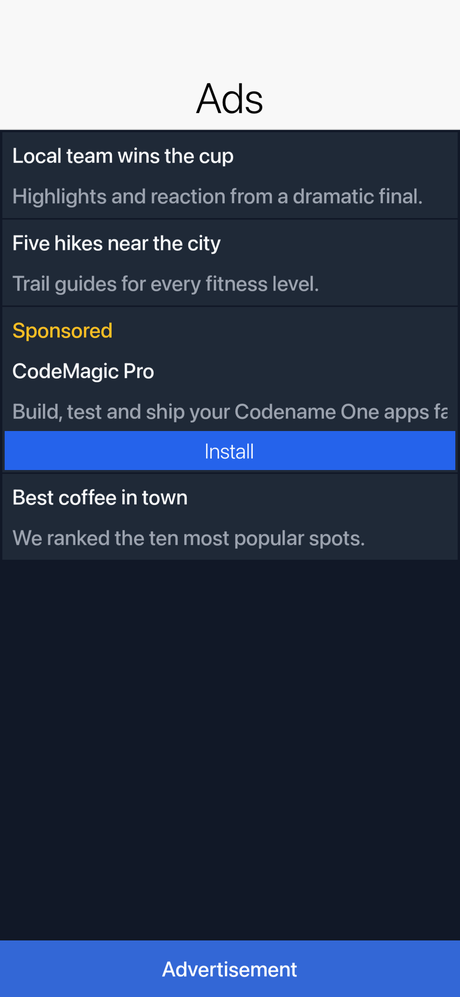
One API, every format
The public API lives in com.codename1.ads. AdManager is the entry point, and there is a type per format: InterstitialAd, RewardedAd, RewardedInterstitialAd, AppOpenAd, BannerAd, and NativeAdLoader. Consent is handled by AdConsent (UMP plus iOS ATT), and AdConfig, AdRequest, and AdListener round out the surface. The whole thing is event-driven and every callback is marshaled onto the EDT, so you never touch ad SDK threading.
A rewarded ad, the format people most often ask about, reads like this:
AdConfig cfg = new AdConfig().testMode(true);
AdManager.initialize(cfg, ok -> {
    if (!ok) {
        return;
    }
    RewardedAd ad = new RewardedAd("your-rewarded-ad-unit-id");
    ad.setAdListener(new AdListener() {
        public void onLoaded() {
            ad.show(reward ->
                grantCoins(reward.getType(), reward.getAmount()));
        }
    });
    ad.load();
});
Consent is a first-class step rather than an afterthought:
AdConsent.requestConsent(status -> {
    if (AdConsent.canRequestAds()) {
        loadAds();
    }
});
Pluggable by design
The provider side is an SPI (Service Provider Interface) in com.codename1.ads.spi: a network-agnostic AdProvider plus session interfaces. Discovery is zero-wiring. AdManager resolves the provider through a single call to install(), so adding an ad cn1lib to your project auto-registers it with no setup code. AdMob, AppLovin MAX, Unity LevelPlay, or your own mediation layer can be swapped without touching app code.
A few things only the core can do, and they are wired in directly:
// Show an interstitial on form transitions, no more often than every two minutes
AdManager.bindInterstitialOnTransition(interstitial, 120000);

// Show an app-open ad when the app returns to the foreground
AdManager.enableAppOpenAds(appOpenAd);
Banners are peer-backed components, so they sit in your layout like any other component.
AdMob as the reference provider
The reference provider is a real, modern AdMob integration shipped as maven/cn1-admob, modeled on the ML Kit cn1libs. It targets Google Mobile Ads v24 and up on Android, the current GAD* APIs with UMP and ATT on iOS, and AdMob mediation works transparently behind it. You will need to add these to your build hints:
android.xapplication=<meta-data android:name="com.google.android.gms.ads.APPLICATION_ID" android:value="ca-app-pub-XXXXXXXX~YYYYYYYY"/>
ios.plistInject=<key>GADApplicationIdentifier</key><string>ca-app-pub-XXXXXXXX~YYYYYYYY</string>
Those hints set the Android APPLICATION_ID manifest meta-data and the iOS GADApplicationIdentifier. For iOS you should also declare your SKAdNetworkItems and an NSUserTrackingUsageDescription (the ATT prompt copy) the same way.
Debugging Ads
The simulator ships a placeholder provider so you can exercise every format and the consent flow, without a device. The AdsSample in the samples repo runs every format against the simulator placeholder if you want to see the flows before you wire up a real account.
A reminder that applies to any ad integration: if you do server-side reward verification, the verification has to happen on your server. Do not trust a reward granted purely on the client, and do not embed any server secret in the app.
The previous deep dive covered WebSockets, gRPC, and GraphQL in the core, and the release post has the full index. Tomorrow’s post, the last of the run, is about background work, push topics, and richer notifications.
Discussion
Join the conversation via GitHub Discussions.