Years ago I wrote a piece called Open Source Bait and Switch. The short version: a project is released as open source while it has no business model, a community forms around it, and then the bill comes due. The project either rots into abandonware because nobody can afford to maintain it, or it sprouts a home-grown “source available” license that quietly takes back the freedoms it was given on. You have watched this happen. So have I.
We have spent fourteen years trying not to become either of those stories. This is a release post, and most of it is the features that shipped this week, but the thread running through them is worth saying out loud first, because two of this week’s headline features, analytics and last week’s crash protection, are the clearest example yet of how we intend to keep the lights on without charging you for the freedom you already have.
The deal we actually offer
Codename One the open source project and Codename One the company are not the same thing, and that distinction is the whole game. The project has to stay open: it is licensed under the GNU GPL with the Classpath Exception, the same license the JDK ships under, so you can fork it, build closed-source apps on top of it, and run the whole build toolchain yourself. That license choice is the point, not a footnote. The piece I linked above argued that the sustainable way to fund open source is a strong copyleft license plus a real commercial offering, not a permissive license you quietly relicense once the community is locked in. Codename One has been GPL with the Classpath Exception the entire time. The exception keeps your apps yours; the copyleft keeps a free, forkable Codename One in the world no matter what the company does or who owns it.
The company still has to make enough money to keep paying the people who move the project forward at the pace you have seen this year. That need pulls against the open one, and the usual way companies resolve the tension is to make the open part worse so the paid part looks better. We said it plainly in We Will Not Sabotage Your Code a couple of weeks ago: we will not do that, and the model below is how we avoid it.
The first answer is the build cloud. Compiling your Java to a native iOS binary on our servers costs us real money in machines and maintenance, so charging for build capacity is fair: you are paying for a thing that has a meter on it. But build credits alone do not fund the pace we have been shipping at, and they never will. We need a second answer that grows.
That second answer is optional services that sit on top of the open source project and enhance it, without ever standing in your way. The rule we hold ourselves to is that they stay optional. Nothing forces you into ours, and where an alternative exists you are free to wire it in instead. What makes ours worth choosing is integration depth, not lock-in: because we run the build servers, we can make a service like crash protection seamless in a way a bolt-on tool cannot, symbolicating native crashes for you with no setup on your side.
Crash protection last week was the first example of that depth. Analytics this week adds a second pattern: a paid provider that sits behind an open Service Provider Interface, so the same code can target a third-party backend just as easily as ours.
(opt-in by default)"} B -->|granted| C["AnalyticsProvider SPI"] B -->|denied| Z["Nothing leaves the device"] C --> D["GoogleAnalyticsProvider (GA4)"] C --> E["MatomoAnalyticsProvider"] C --> F["FirebaseAnalyticsProvider"] C --> G["CodenameOneAnalyticsProvider
(first-party, included with a subscription)"] style G fill:#1f6feb,color:#fff
You can wire the analytics facade to Google Analytics, to Matomo, to Firebase, or to your own AnalyticsProvider, and the framework does not care which. If you pick our first-party provider you get a privacy-oriented analytics backend with the consent handling already done, and you also fund the next port, the next API, the next year of this. That is the entire pitch. It is not a tax on the open source project; it is a better default that happens to also pay for the open source project.
We are going to keep adding services in this shape, and we are open to requests for which ones. We’d love to hear from you in the comments below. If the model makes sense to you, the most useful thing you can do is help us tell people about these services. Promoting them is not a betrayal of the open source ethos; it is the thing that keeps the open source project from becoming one of the two sad endings above.
Here is what we shipped this week.
A privacy-first analytics API
PR #5266 replaces the old Google Analytics v1 AnalyticsService with the generic provider SPI shown above. You register one or more AnalyticsProvider implementations with the Analytics facade, and it fans screen, event, setUserProperty and crash calls out to all of them, but only after a consent gate that is opt-in by default and persists the user’s choice across restarts. The client id is pseudonymous and resettable, and no hardware identifiers are touched.
Analytics.addProvider(new MatomoAnalyticsProvider("https://stats.example.com", 7));
Analytics.setConsent(AnalyticsConsent.builder().analytics(true).build());
Analytics.event(AnalyticsEvent.create("checkout")
        .category("commerce")
        .param("plan", "pro")
        .build());
Five providers ship in the box: our first-party CodenameOneAnalyticsProvider (batched to the cloud, included with every paid subscription down to the basic tier, where the plan sets your data-retention window), GoogleAnalyticsProvider for GA4, the privacy-first non-Google MatomoAnalyticsProvider, FirebaseAnalyticsProvider, and a LoggingAnalyticsProvider for development. The old AnalyticsService is still there, deprecated, and now delegates to the new API so existing apps keep working. The full walkthrough is in Monday's post.
Maps you control, down to the pixel
PR #5264 brings mapping back into core and modernizes it, retiring the old tile-based MapComponent and the external Google Maps cn1lib. Two components share one MapSurface API. The one I am most excited about is MapView, a pure-vector map rendered entirely through Graphics, with a Mapbox Vector Tile engine built on the framework’s own ProtoReader and GeneralPath. There is no native peer, which means no z-order fights, no snapshot-during-animation compromise, and identical rendering everywhere including the simulator and the web. You host your own tile data and metadata, pick a light or dark style, and you control every pixel that gets drawn.
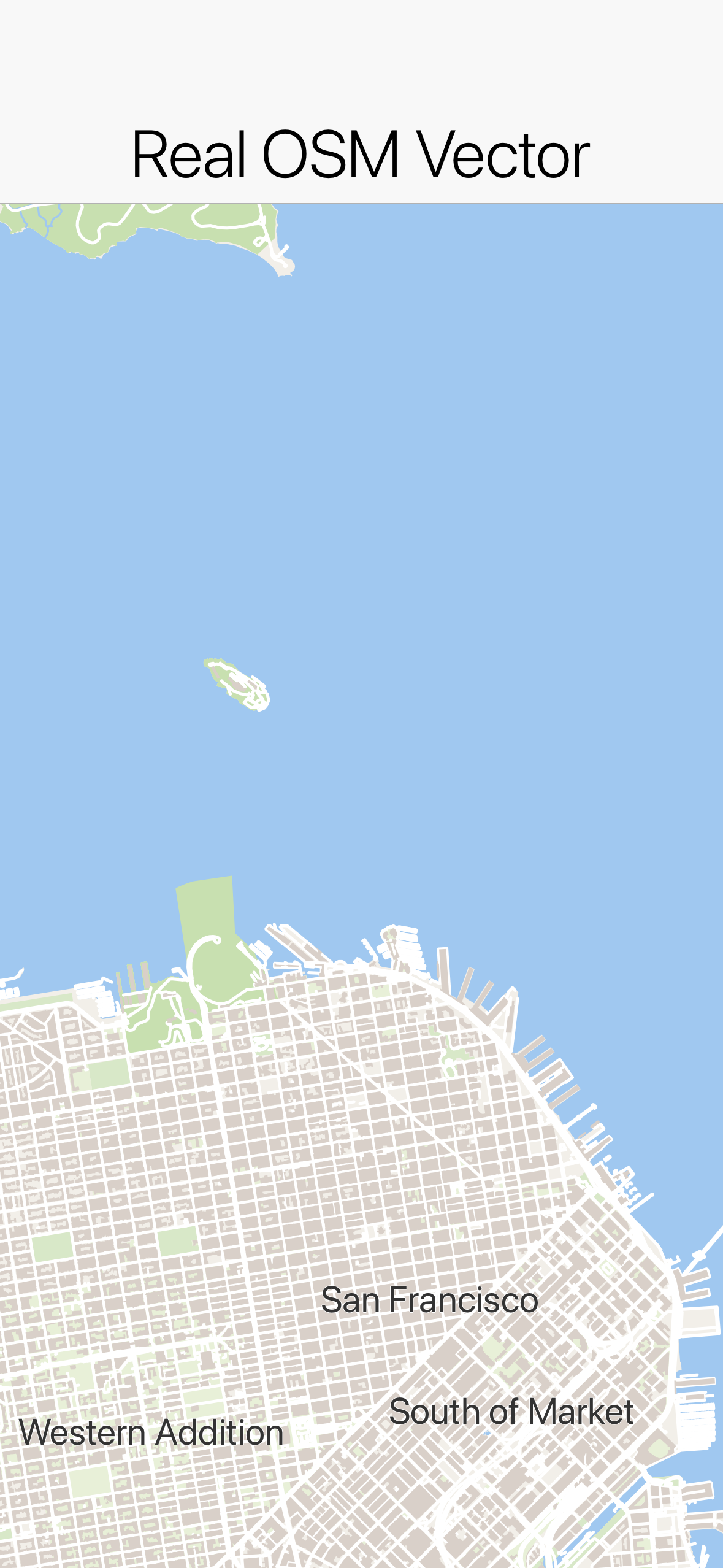
The second component, NativeMap, gives you a real native map from a provider like Apple MapKit or Google Maps, wired through an SPI selected by a build hint rather than code. The old Google Maps cn1lib tied you to one vendor; this does not. Because the provider is injected at build time, the core and ports carry no map SDK, unused providers cost zero project size, and a device without Google Play, a Huawei phone for instance, is one build hint away from a working native map instead of a porting dead end. When no provider is configured, NativeMap falls back to an embedded MapView. The engine and the provider model are covered in Saturday's post.
Apple TV, Android TV, and CSS that knows the form factor
PR #5261 adds Apple TV (tvOS) and Google TV (Android TV) support, modeled on the Apple Watch port from last week. The same CN.isTV() branch you would expect, the same single Android APK running on phones, tablets and the television, and on iOS a separate tvOS Xcode target driven by a build hint.
The part with the most day-to-day reach is in the styling layer. The CSS engine now understands device form factors as @media variants, so you adapt to the ten-foot living-room view, or to the watch, in your stylesheet instead of in branching code:
@media device-tv {
  Title { font-size: 3rem; }
}
@media device-watch {
  Title { font-size: 0.8rem; }
}
That work also finished wiring @media for the existing watch port, which never had it. Apple TV builds from the same project once you point codename1.tvMain at a tvOS target, and the framework’s screenshot suite already renders the full component set on the Apple TV simulator. The form-factor API and the @media styling, with real Codename One UI running on the TV, are covered in Tuesday's post.
Rich text and code editing
PR #5272 adds two visual editors. RichTextArea is a WYSIWYG HTML editor, bold, italic, lists, links, colors, headings, with getHtml and setHtml. CodeEditor is an IDE-style editor with syntax highlighting for eight languages, a line-number gutter, light and dark themes, bracket and quote auto-close, asynchronous code completion, and diagnostics that render as squiggly underlines with gutter markers and tooltips.
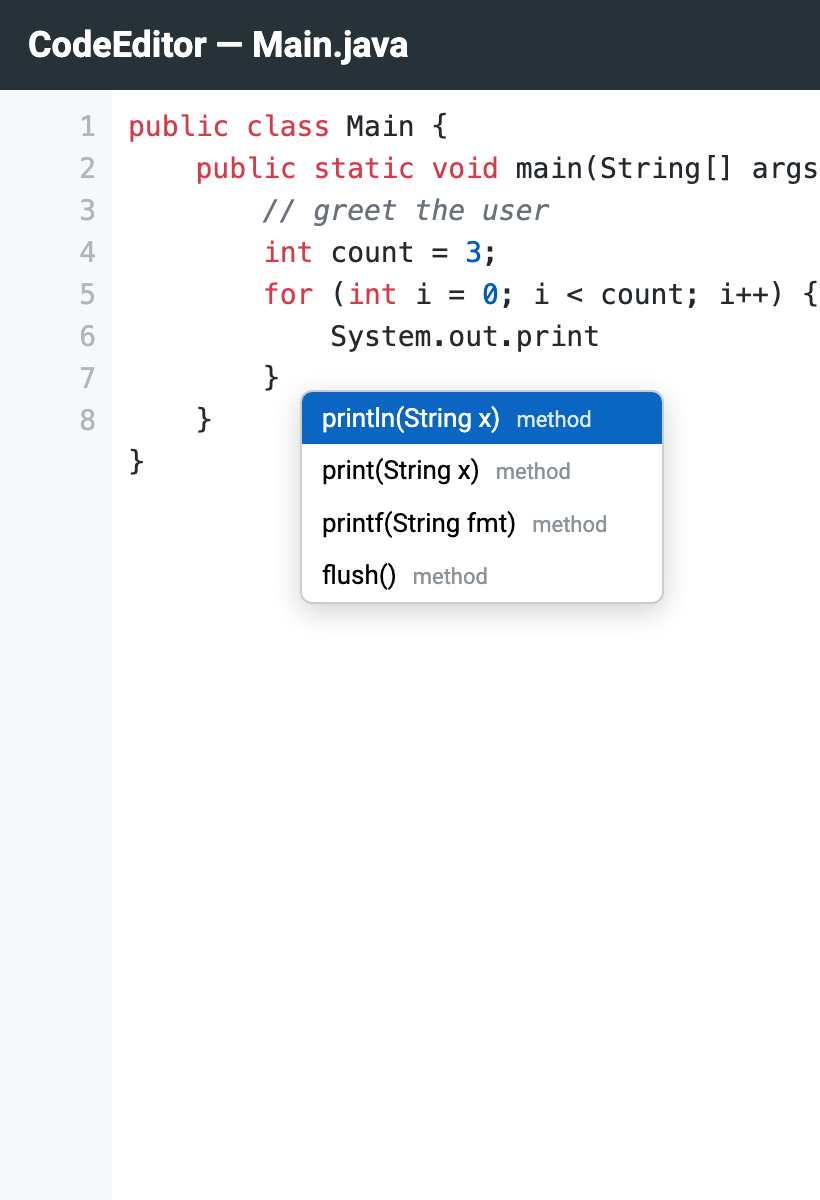
Both sit on a single AbstractEditorComponent with two interchangeable backends: a fully cross-platform engine made of self-contained HTML and JS inside the core jar, and an optional richer native backend a port can supply. The CodeEditor is not a toy demo: the Playground already uses it. The deep dive is in Sunday's post.
Device integrity and app review
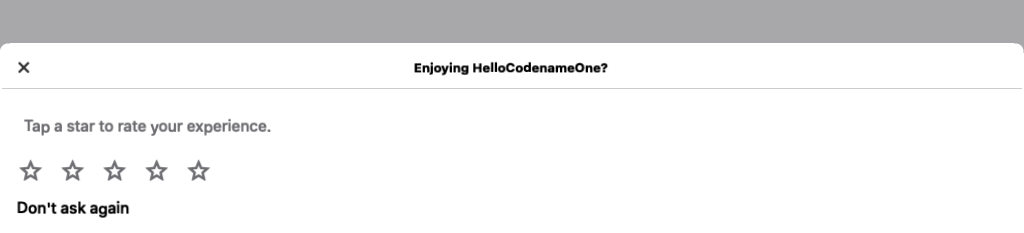
Two smaller APIs round out the week, both built in core rather than as cn1libs. PR #5277 adds DeviceIntegrity, a portable runtime self-protection API for high-security apps: Play Integrity and iOS App Attest attestation, root, jailbreak and Frida detection, and an accessibility-service abuse guard, most of it driven by build hints with a runtime API on top. We already have several customers in banking and payments, and Codename One is hardened to meet the requirements they bring; this API is part of that work. PR #5268 adds AppReview, which uses the platform’s native store-review prompt where it exists and falls back to a built-in widget everywhere else, with a feedback split that quietly routes unhappy users to you instead of to a one-star public review.
Both are covered in Wednesday's post.
The state of the JavaScript port
The Playground is now built with our own JavaScript port. PR #5250 moved it off a pinned old release and onto our ParparVM-based JavaScript port, the same path the Initializr now uses. The visible payoff is that the Playground tracks the current API directly, so new API demos, including the 3D ones, run in the browser without a special-case build.
Getting here has been whack-a-mole in the most literal sense. The Playground’s reflective access registry references nearly the whole API, which exercises paths a normal app never touches, and each one surfaced its own translator bug. Array class literals like byte[].class threw Unsupported ldc constant because the JS backend only handled object class literals. A Throwable caught mid-emit was rethrown only if it was an Exception, so an OutOfMemoryError could let the translator exit successfully with a truncated, broken bundle. A varargs array of arrays generated malformed new byte[][len] instead of new byte[len][]. None of these are exotic on their own; the Playground just hits all of them at once.
This is the hardest port we have ever built, and every percentage point of compatibility is earned one fixed bug at a time. The JavaScript port is now aligned with the other ports; what is left is getting it production-ready, and we are in the final stages of that. We hope to reach that point in the near future. Stay tuned.
From the community
If you write about Codename One, on a blog, on Stack Overflow, in a forum, this is the season we most appreciate it. Community activity slows over the summer, and the services we described at the top are funded in part by people finding the project in the first place. Pointers to good writing, and new writing of your own, both help.
Upcoming attractions
We have a week full of feature deep-dives:
- Saturday. Vector and native maps. PR #5264.
- Sunday. Rich text and code editing. PR #5272.
- Monday. The privacy-first analytics API. PR #5266.
- Tuesday. Apple TV and Android TV. PR #5261.
- Wednesday. Device integrity and app review. PRs #5277 and #5268.
- Thursday. Game Builder tutorial 2, a blackjack card game. PR #5253.
Wrapping up
The best place to reach us is the comments on this post, including requests for which optional service you want next. The issue tracker and the discussion forum are there too, and the Build Cloud console is at /console/. The Playground, Initializr, and Skin Designer are where they have always been.
Discussion
Join the conversation via GitHub Discussions.